Demystifying evals: Anthropic's method for evaluating agents, tracked over time
Graders, pass@k vs pass^k, the eight-step roadmap and the Swiss cheese model of quality: a living entry on Anthropic's evals guide, with the official diagrams and a dated history of the page.
Building effective agents ends on one piece of advice: only add complexity when you can measure that it helps. Demystifying evals for AI agents, published on January 9, 2026, is the manual for that measurement. It is the text I reread whenever an agent "feels worse" and I cannot say why. This entry sums up what the page says today, and the history at the bottom dates every change to it.
The vocabulary, pinned down once
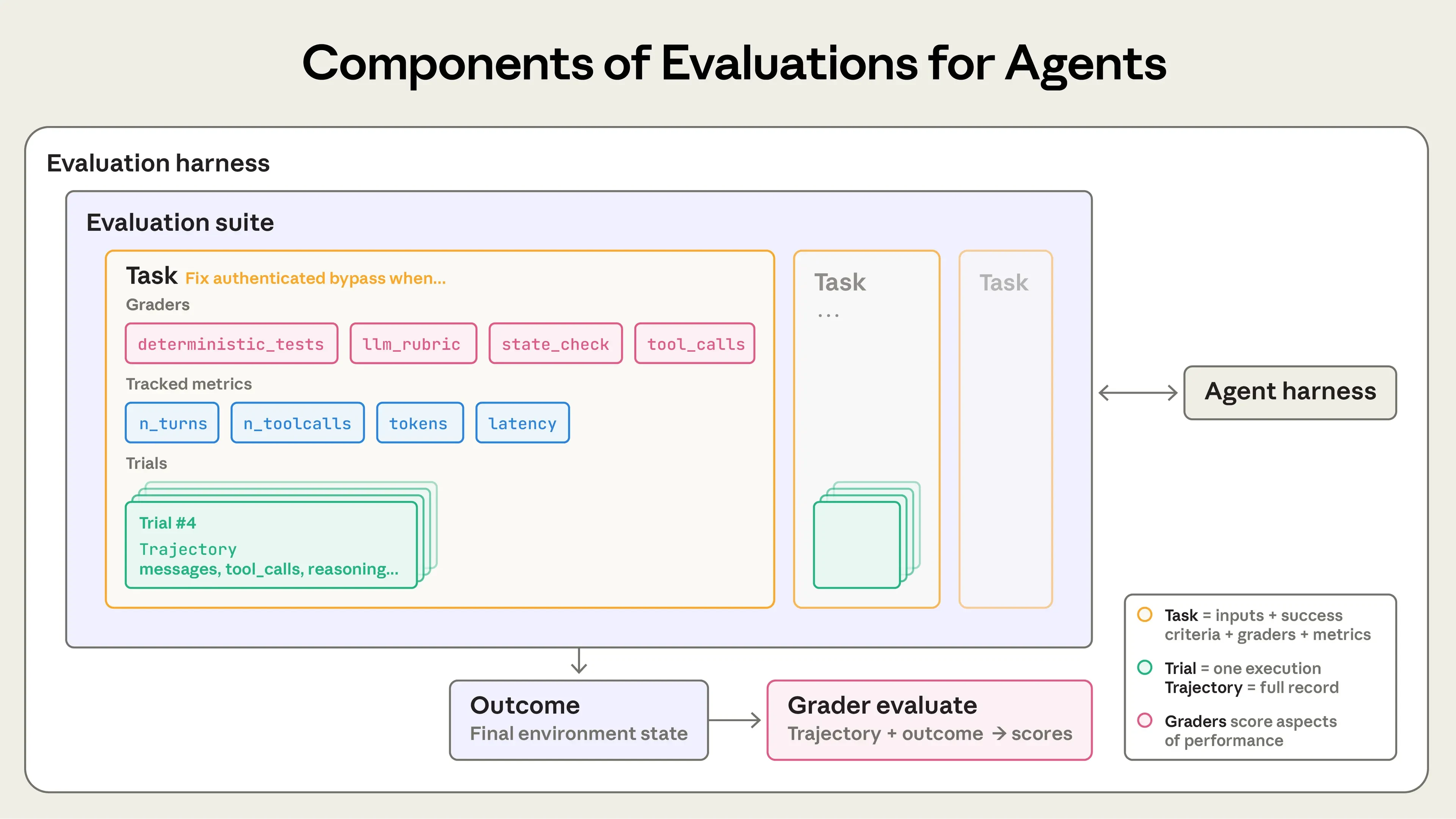
The post opens by fixing its terms, and that is the part worth keeping at hand. A task is a test with inputs and success criteria. Each attempt is a trial, and you run several because outputs vary between runs. A grader scores one aspect of performance. The transcript is the full record of a trial. The outcome is the final state of the environment.
The transcript vs outcome distinction is the most useful one. The post's example: a booking agent can say "your flight has been booked", but the outcome is whether a reservation actually exists in the environment's SQL database.
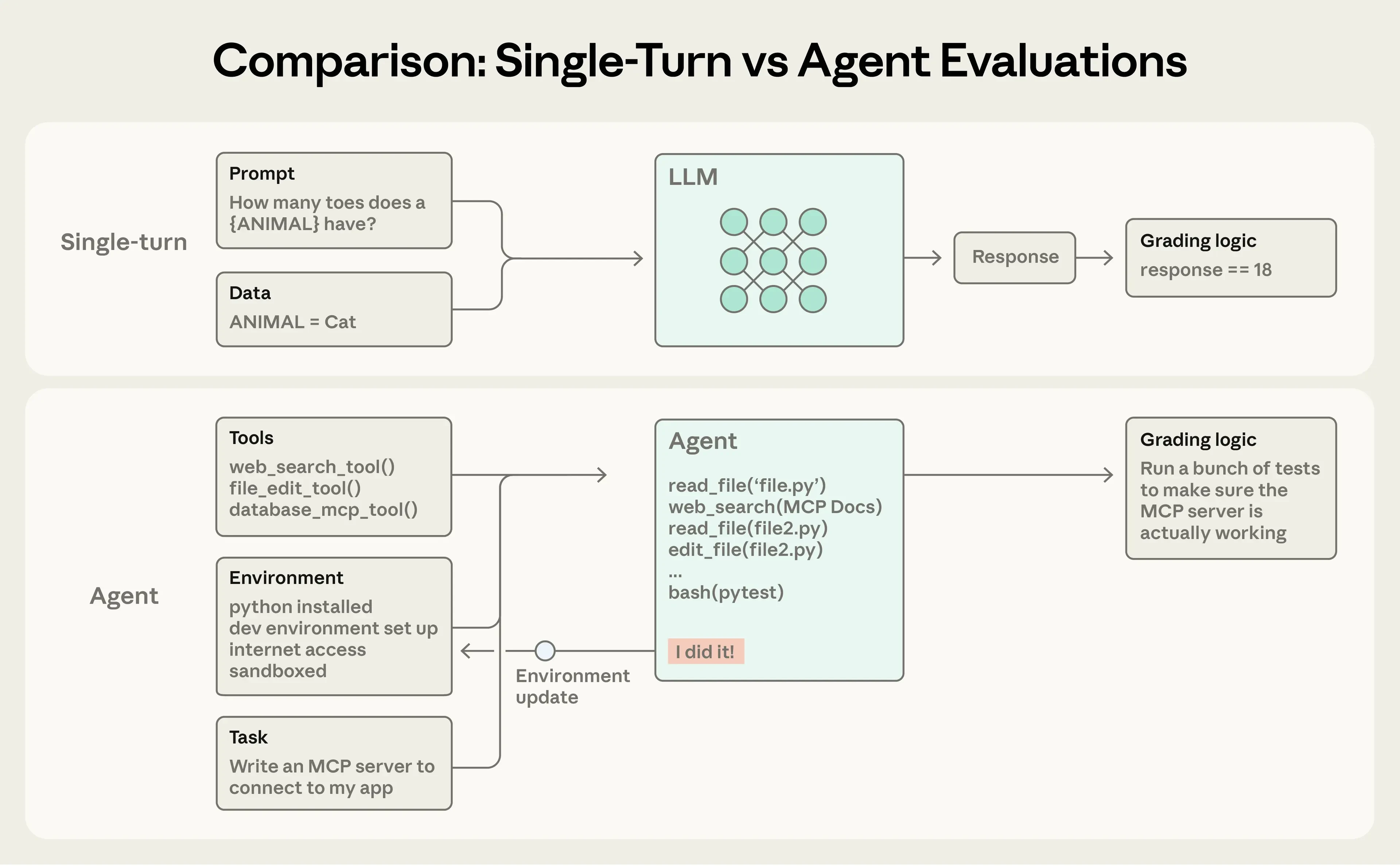
One more nuance that matters: you never evaluate a model alone. You evaluate an agent harness (the system that makes the model act) and the model together. The post names Claude Code as a flexible harness, and the Agent SDK as the base of their harness for long-running agents.
Why start before you need it
Early on, manual testing and dogfooding get you surprisingly far. The breaking point comes when users say the agent got worse and the team is flying blind. Without evals you wait for complaints, reproduce by hand, fix, and hope nothing else broke.
Anthropic tells the Claude Code story: fast iteration on feedback at first, then narrow evals (concision, file edits), then subtler behaviors like over-engineering. The post also cites Descript, which grades its video edits on three axes (don't break things, do what I asked, do it well), and the Bolt team, which built its eval system in three months while its agent was already widely used.
The argument that lands hardest for me: evals set how fast you can adopt new models. Without them, each new model costs weeks of testing. With them, you know within days what it brings and you tune your prompts.
Three kinds of graders
| Grader | Strengths | Weaknesses |
|---|---|---|
| Code (string matching, binary tests, static analysis, state and tool-call checks) | fast, cheap, objective, reproducible | brittle to valid variations, little nuance |
| Model (rubrics, natural-language assertions, pairwise comparison, multi-judge consensus) | flexible, captures nuance, handles free-form output | non-deterministic, pricier, needs calibration against humans |
| Human (experts, spot-checks, A/B tests) | gold standard, used to calibrate the others | expensive, slow, hard to scale |
Source: the post's tables, condensed.
The post also separates two uses. Capability evals ask what the agent does well: they should start at a low pass rate, so there is a hill to climb. Regression evals check it still does what it used to: they should sit near 100%. A capability eval that saturates can "graduate" into the regression suite.
What changes by agent type
Coding agents. Deterministic graders are the natural fit: the code runs and the tests pass, or not. The post notes LLMs went from 40% to over 80% on SWE-bench Verified in one year. It gives a YAML example combining tests, an LLM rubric, static analysis, state checks and tool-call checks, while noting that in practice you usually stick to unit tests plus a quality rubric.
Conversational agents. The quality of the interaction is part of what you grade, and you often need a second LLM to play the user. The τ-bench and τ2-bench benchmarks work this way.
Research agents. Quality depends on context. The post suggests combining groundedness checks (each claim backed by a source), coverage checks (key facts present) and source quality checks.
Computer use agents. Run them in a real or sandboxed environment and check the end state, not the confirmation page. A concrete detail from Claude for Chrome: extracting the DOM is fast but token-hungry, screenshots are slower but cheaper, and an eval checks the agent picks the right tool for the context.
pass@k vs pass^k
An agent does not behave the same way twice: it solves one task 90% of the time, another 50%. Two metrics capture this, and they tell opposite stories.
- pass@k: the probability of at least one success in k trials. It goes up with k.
- pass^k: the probability that all k trials succeed. It goes down with k. The post's example: a 75% per-trial success rate gives (0.75)³ ≈ 42% odds of passing three times in a row.
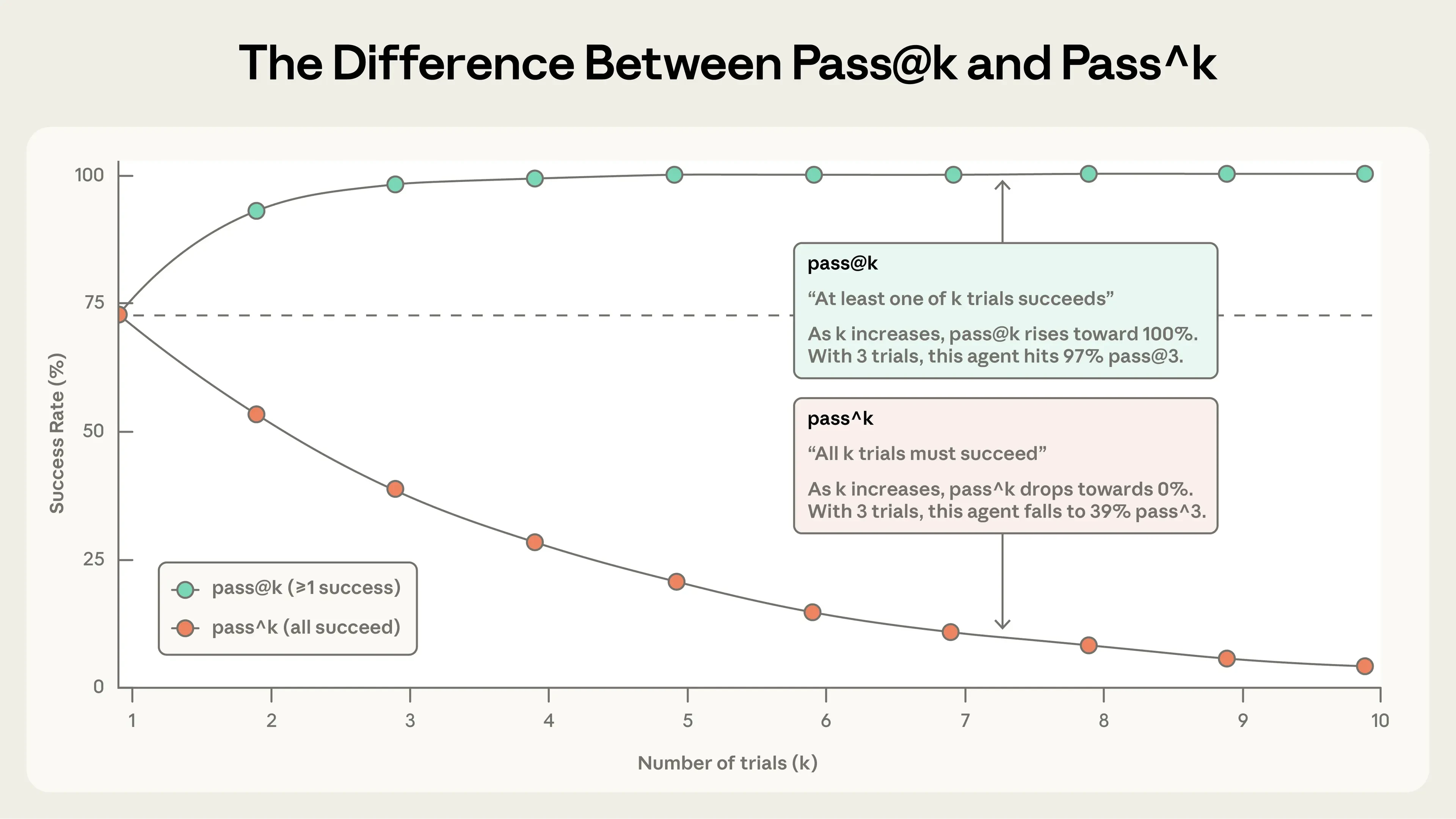
How to choose: pass@k for a tool where one success is enough, pass^k for an agent facing customers who expect the same result every time.
The eight-step roadmap
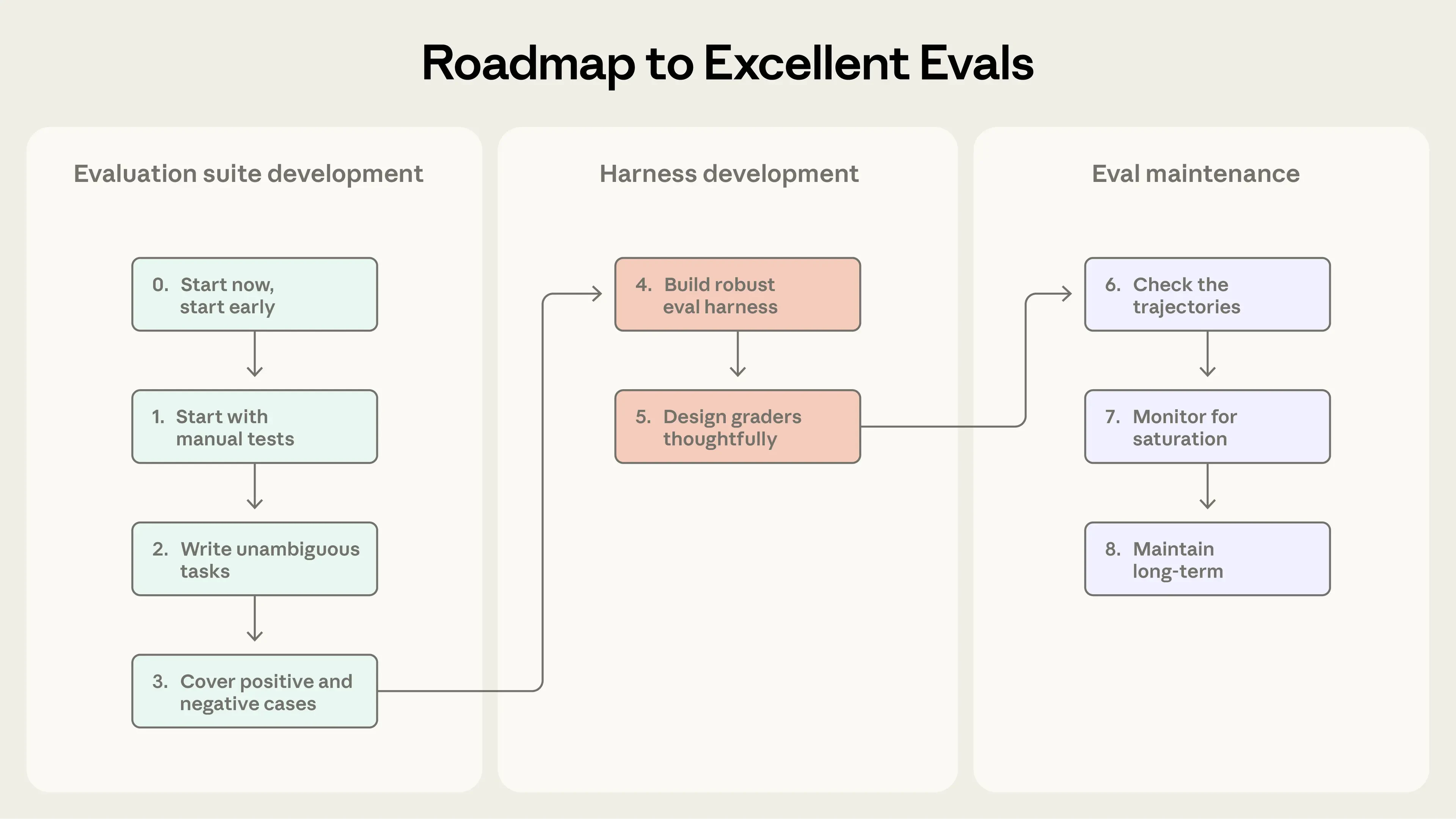
What I take from each phase.
Building the suite. You do not need hundreds of tasks: 20 to 50 tasks drawn from real failures are enough to start, because early changes have visible effects. A good task is one where two experts would reach the same verdict. And a signal worth knowing: with current models, 0% success over a hundred trials usually means a broken task, not an incapable agent. Test behaviors in both directions too. The Claude.ai team learned it on web search: only checking "searches when it should" gives you an agent that searches for everything.
Building the harness. Every trial starts from a clean environment. The post recounts Claude gaining an unfair edge on some tasks by reading git history left over from earlier trials. On graders, the counterintuitive rule: grade what the agent produced, not the path it took. Enforcing a sequence of tool calls punishes valid solutions nobody anticipated. Build in partial credit, and give the LLM judge a way out ("Unknown") to limit hallucinations.
The story behind the whole section: Opus 4.5 first scored 42% on CORE-Bench, until an Anthropic researcher found overly rigid grading ("96.12" rejected when "96.124991…" was expected), ambiguous specs and tasks impossible to reproduce. Once fixed, the score jumped to 95%, according to the thread the post links as its source.
Maintaining. Read the transcripts, always: it is the only way to know whether a failure comes from the agent or the grader. Watch for saturation: an eval at 100% no longer measures progress. And treat the suite like unit tests, with a team owning the infrastructure and product teams adding tasks. The post even suggests product managers or salespeople contributing eval tasks as pull requests with Claude Code.
The Swiss cheese model of quality
Automated evals are only one layer. The post compares them with production monitoring, A/B tests, user feedback, manual transcript review and systematic human studies, each with its blind spots.
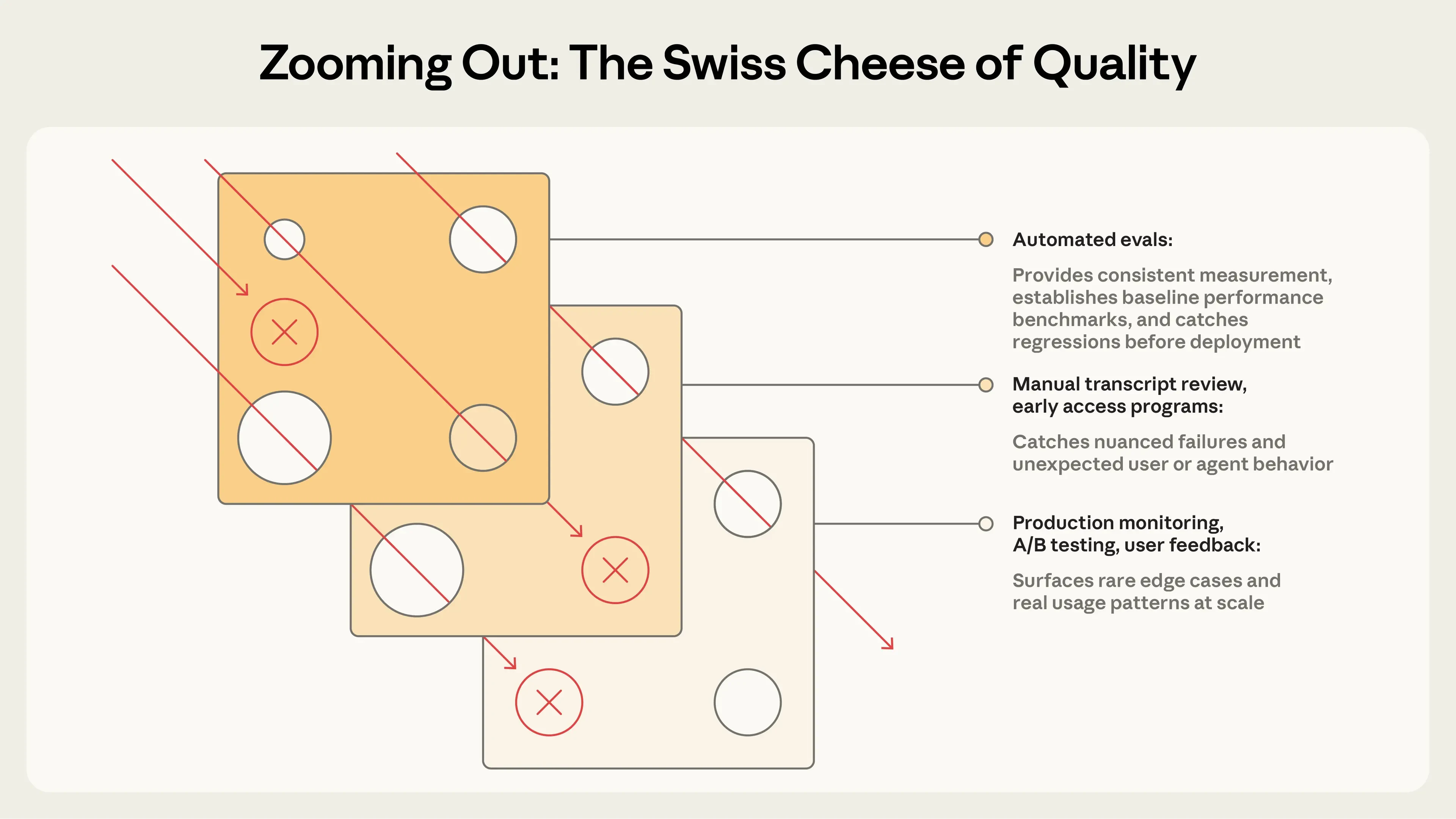
The final recipe fits on one line: automated evals for fast iteration, production monitoring for ground truth, periodic human review for calibration.
I apply it on this site. The Claude Code changelog digests go through a code gate (accents, sourcing, length by level), then an LLM reviewer, before being published automatically: a code grader plus a model grader, exactly the combination the post describes. The gate behind this research watch section follows the same logic.
The frameworks it lists
In its appendix the post lists Harbor, Braintrust, LangSmith, Langfuse and Arize. Its take: a framework speeds you up, but it is only as good as the tasks you run through it. Pick one fast, invest in tasks and graders.
This list is the passage most likely to change. In Building effective agents, the frameworks list is exactly what got rewritten twice in a year. If this one moves, the history below will say so.
History of the official page
Every change, dated and verifiable. Most recent first.
- Copy edit verify
The five diagrams are now served from assets.claude.com instead of www-cdn.anthropic.com, with different resizing parameters. No change to the text or to the diagrams themselves.
- Address verify
The page moves from
/engineering/to/research/as part of the section redesign. The text is unchanged; only the comparison tables get a new layout. - Copy edit verify
A copy-editing pass across the whole post: punctuation, capitalization in quoted questions, dashes, and a typo that split a paragraph in two. No change in substance.
- Content verify
Less than 24 hours after publication, Anthropic softens a claim: multi-turn, agentic evaluations no longer "have become predominant", they "have become increasingly common".
- Published verify
Published by Mikaela Grace, Jeremy Hadfield, Rodrigo Olivares and Jiri De Jonghe, under
/engineering/.

Pierre Rondeau
AI Engineer. I build AI agents and get them ready for production: datasets, evals, observability. Creator of Claude Hub.
LinkedIn