Building effective agents: Anthropic's guide, broken down and tracked over time
Workflows vs agents, the five patterns, the three principles and the appendix on tools: a living entry on Anthropic's guide, with the official diagrams and every change to the page dated.
Whenever someone asks me how to build an agent, I send them to Building effective agents. It dates from December 2024, takes about twenty minutes to read, and has aged better than most of the frameworks it used to mention. It has also moved: rewritten tool list, updated example models, a warning note added in 2026. This entry sums up what the page says today, and the history at the bottom dates every change, each with a link you can check.
Workflows vs agents: the distinction everything hangs on
Anthropic files everything that combines an LLM with tools under agentic systems, then draws an architectural line:
- a workflow orchestrates the model and tools along code paths written in advance;
- an agent directs its own process and tool use, and stays in control of how the task gets done.
The difference is not about power. It is about who holds the wheel: your code or the model. And it comes at a price: agentic systems trade latency and cost for task performance. The guide is blunt about it. Often the right answer is no agent at all, and a single well-optimized call with retrieval and a few examples is enough in many cases.
Frameworks: what the page recommends, and what changed
The advice has not moved since 2024: start by calling the API directly, many patterns fit in a few lines of code. If you do use a framework, understand what it does underneath.
Incorrect assumptions about what's under the hood are a common source of customer error.
What got rewritten is the list of examples. In December 2024 it named LangGraph and Amazon Bedrock's agent framework. Since late 2025 it names the Claude Agent SDK and AWS's Strands Agents SDK, next to Rivet and Vellum, which stayed. Same advice, examples that follow the tooling.
In August 2026 Anthropic went further with a note at the top of the post: the tooling has changed a lot since December 2024, and the current approach lives in the post on Claude Managed Agents and the Managed Agents documentation. Read it this way: the patterns are still the reference, the recommended tooling is not. For the cost-control angle, see Managed Agents and the kill switch.
The building block: the augmented LLM
Before the patterns comes the brick: a model with retrieval, tools and memory, which it uses on its own (writing its own queries, picking a tool, deciding what to keep).
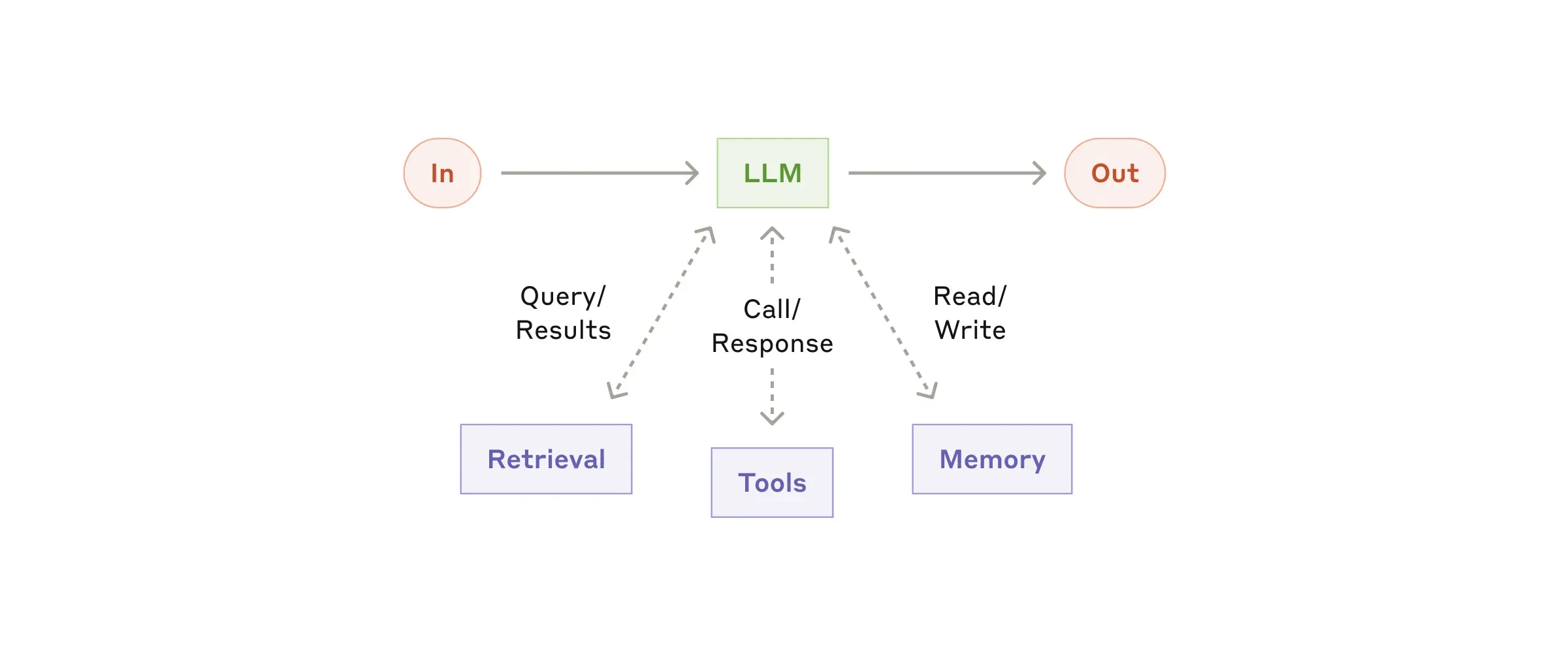
Two priorities, per the guide: tailor these capabilities to your use case, and give them a simple, well-documented interface. The Model Context Protocol is named as one way to do it.
The five workflows
They go from most predictable to most flexible. For each one the guide gives a use case and two examples. Here is what matters.
Prompt chaining
The task is split into fixed steps, each call works on the previous output, and programmatic checks (the "gate" in the diagram) can stop the chain when it drifts.
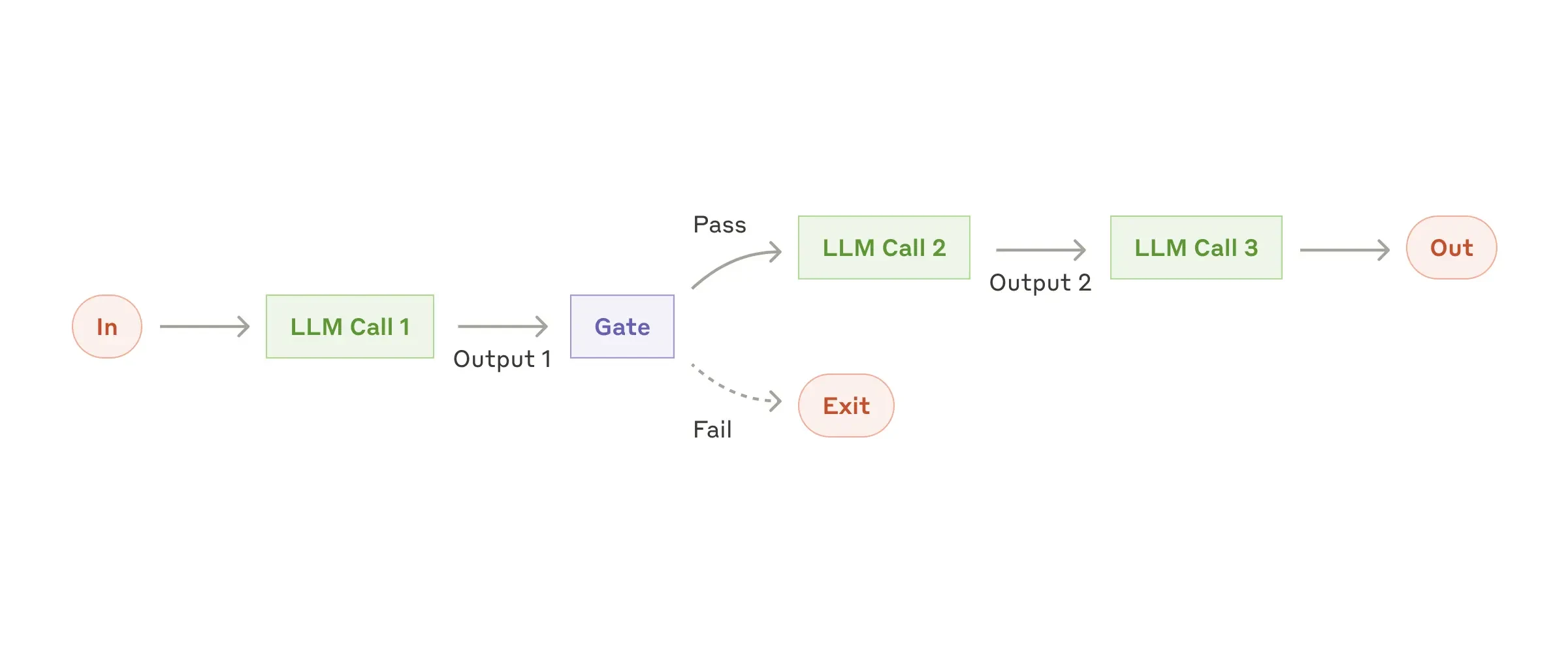
When to use it: the task splits cleanly into subtasks you know in advance. The guide's example: write an outline, check it meets some criteria, then write the document from it.
Routing
A first call classifies the input and sends it to a specialized path. The gain is separation of concerns: tuning a prompt for one kind of request no longer hurts the others.
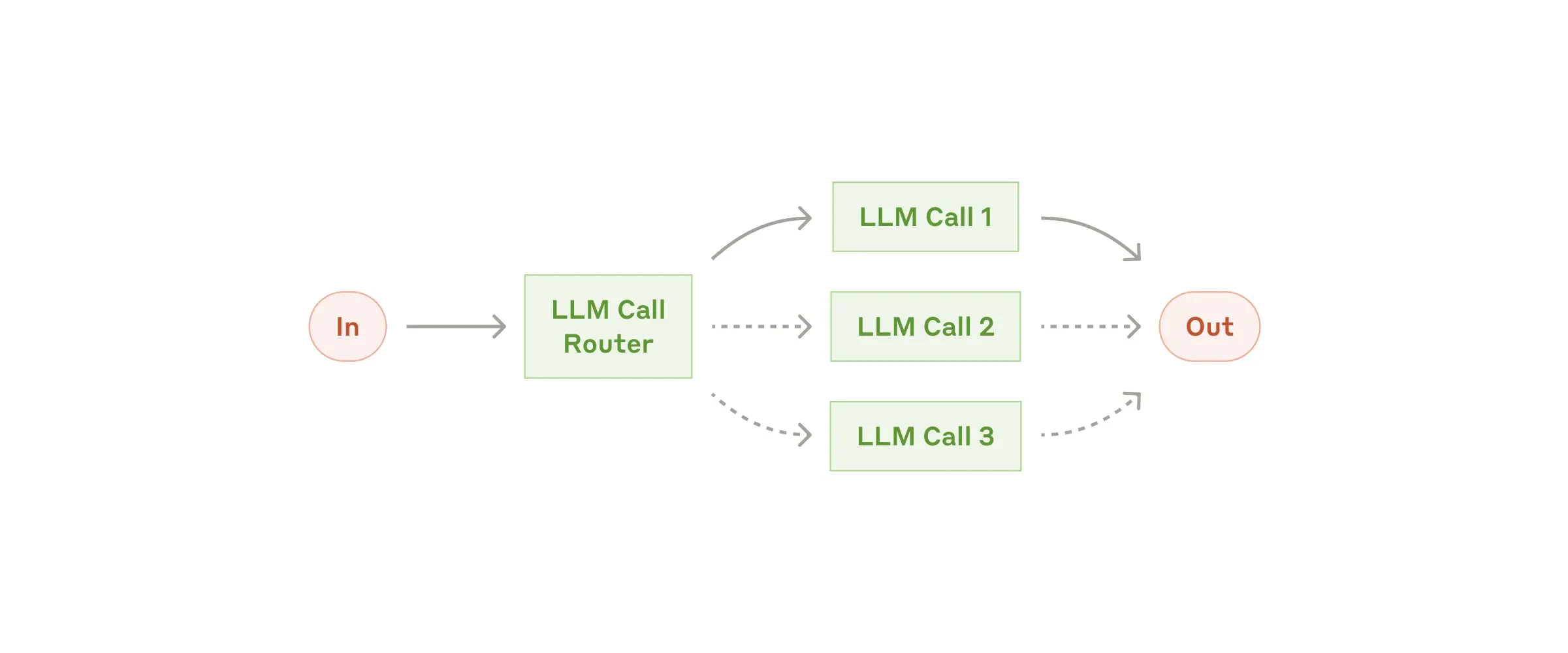
This is the example that changed over time: easy questions go to a small model, hard ones to a more capable one. The page now names Claude Haiku 4.5 and Claude Sonnet 4.5, where the original said Claude 3.5 Haiku and Claude 3.5 Sonnet. Model names age, the principle does not.
Parallelization
Several calls run at once and code aggregates their outputs. Two variants: sectioning (independent subtasks) and voting (the same task several times, to cross-check).
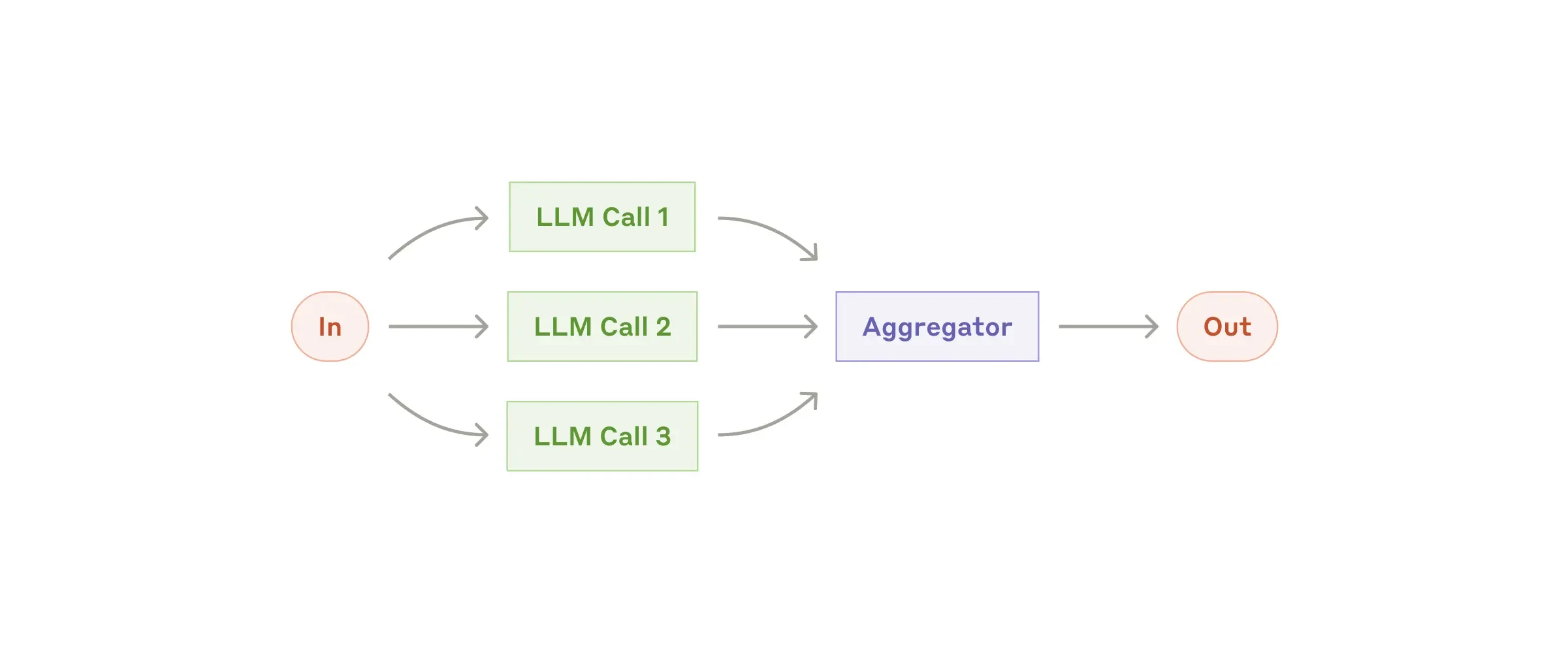
The most practical point: one call handling both the answer and the guardrails does worse than two calls, one answering and one screening. Same logic for a code security review run by several independent prompts.
Orchestrator-workers
A central LLM breaks the task down on the fly, delegates to workers and synthesizes the results. It looks like parallelization, except the subtasks are not known in advance: the orchestrator decides them based on the input.
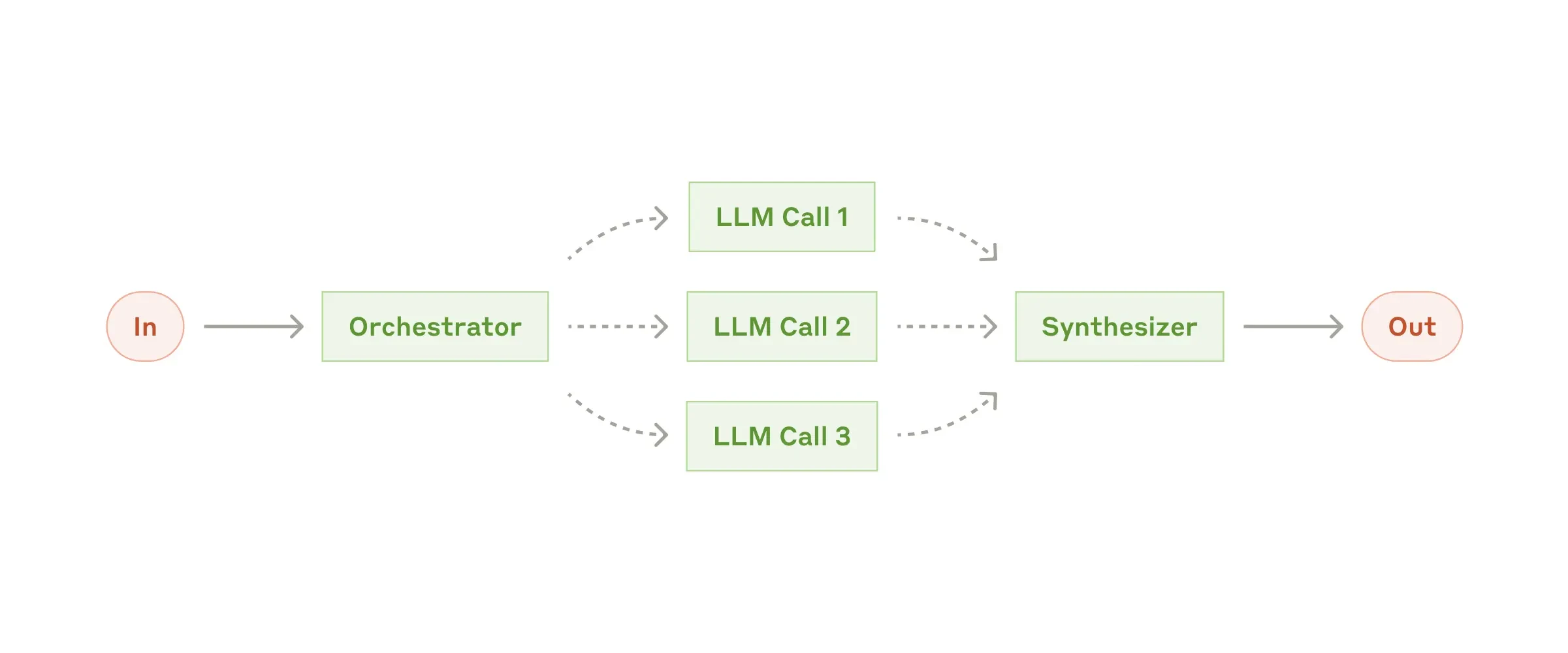
The textbook case is a code change where you cannot tell upfront how many files it will touch. That is exactly what Claude Code does when it spins up subagents.
Evaluator-optimizer
One call produces, another evaluates and sends feedback, in a loop. The guide gives two signs of a good fit: responses clearly improve when a human gives feedback, and an LLM can give that feedback itself.
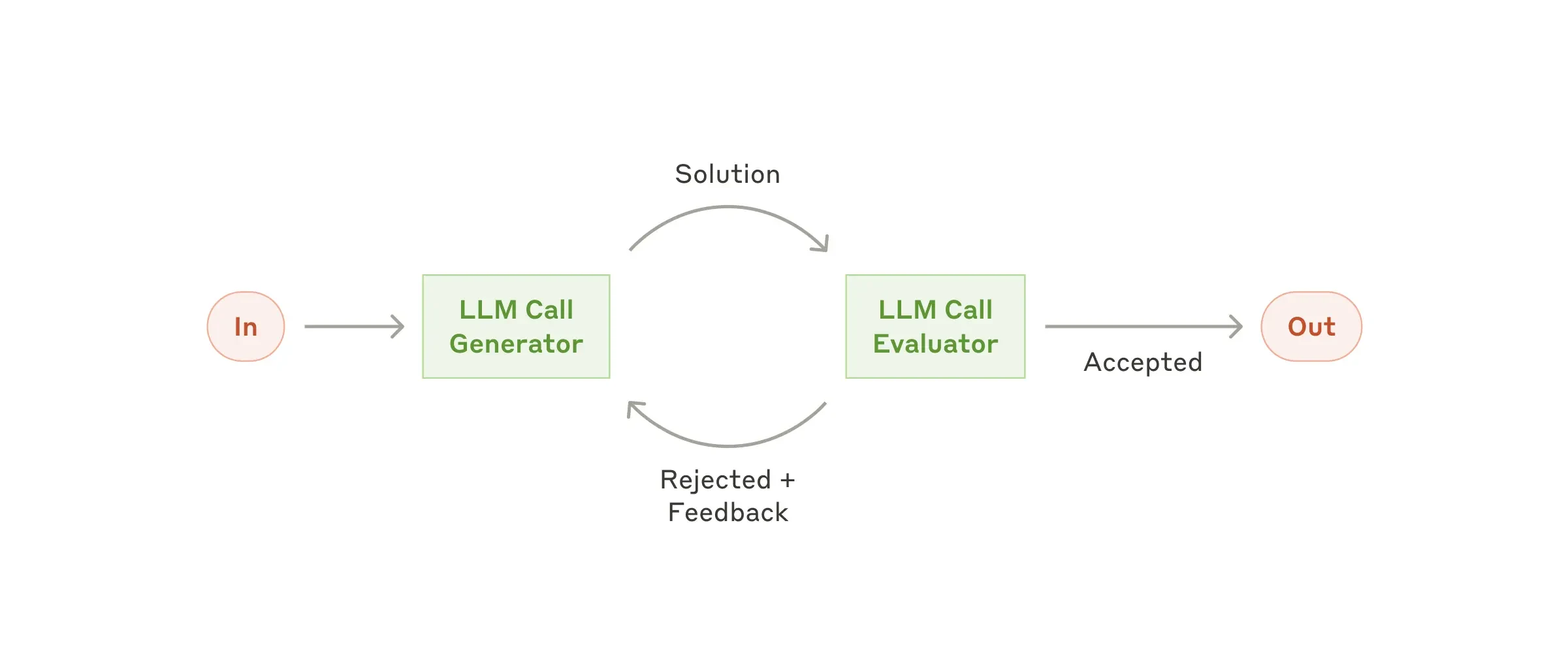
It is the pattern closest to how people write by hand: a first draft, a critical read, a rewrite.
Autonomous agents
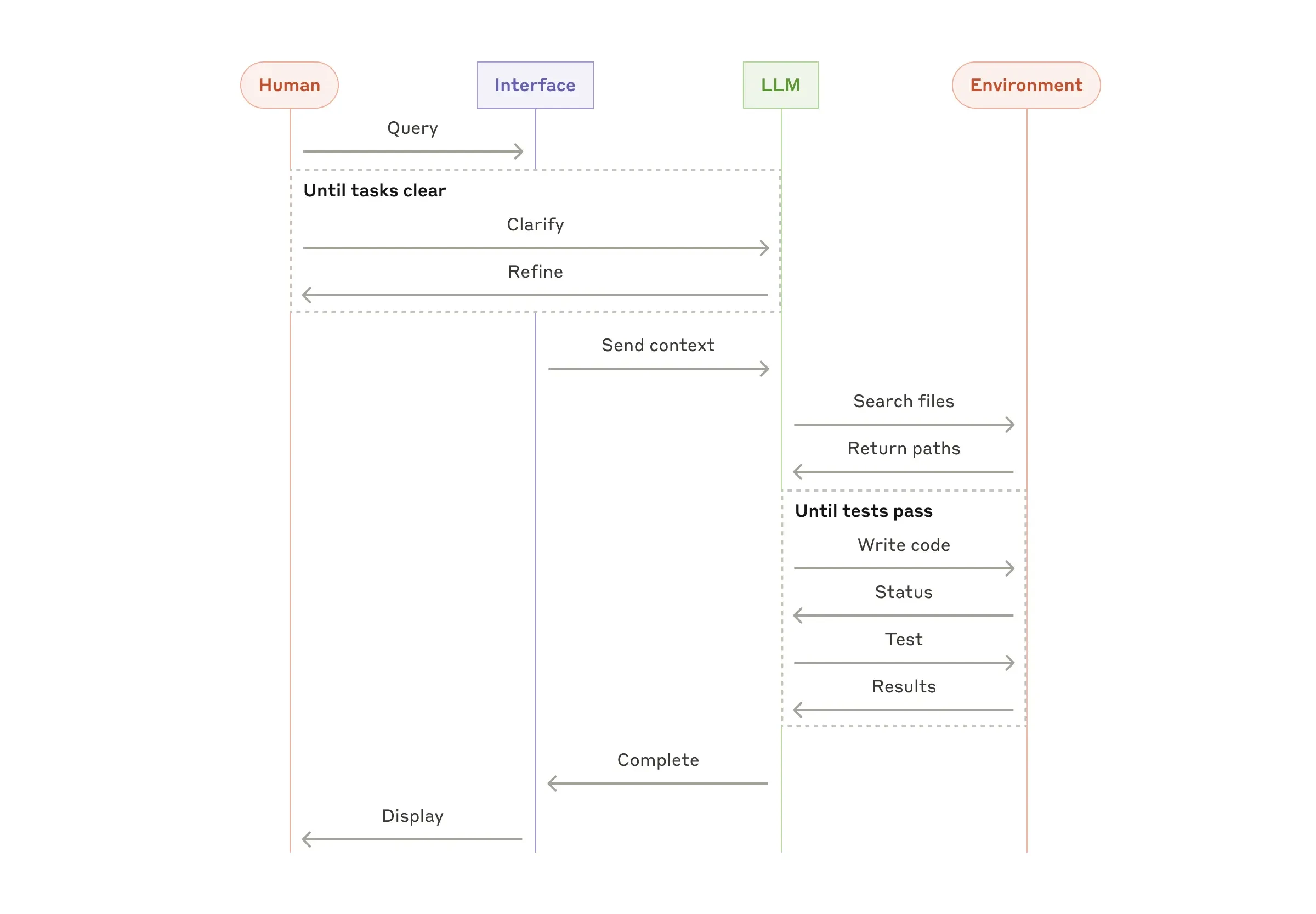
An agent starts from an instruction or a conversation with a human, then plans and acts on its own. The guide stresses one thing: at every step the agent needs ground truth from its environment (tool results, code execution) to know where it stands, and you need stopping conditions such as a maximum number of iterations.
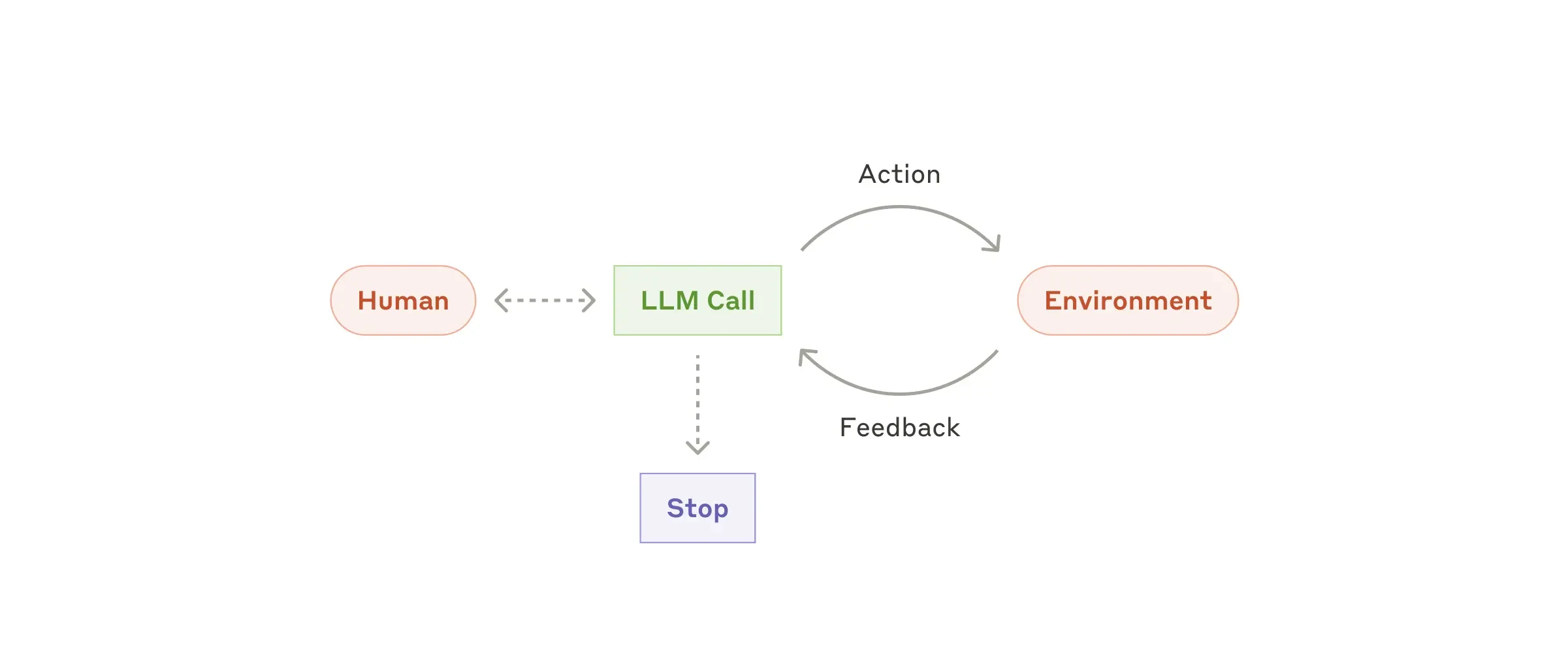
The sentence that takes the mystery out of it:
They are typically just LLMs using tools based on environmental feedback in a loop.
Which means an agent is mostly as good as its tools and their documentation. Autonomy costs more and lets errors compound, so the guide recommends extensive testing in sandboxed environments, with guardrails.
The three principles
The post's summary boils everything down to three rules:
- Keep the agent's design simple.
- Favor transparency by showing the planning steps explicitly.
- Invest in the agent-computer interface (ACI), through tool documentation and testing.
The patterns are not a recipe: they are pieces to combine, and the only way to know whether a combination is worth its complexity is to measure it. That is where the post points, without naming it, to Anthropic's other reference text: Demystifying evals for AI agents, which also has a tracked entry here.
The appendix people skip: get your tools right
The second appendix is the most directly usable part. The idea: a tool definition deserves as much prompt work as the main prompt. The suggested rules:
- give the model enough tokens to think before it writes itself into a corner;
- keep formats close to what the model has seen naturally on the web;
- avoid formats that require bookkeeping, like counting lines for a diff header or escaping code inside JSON.
Above all, design the agent-computer interface with as much care as a human one: name parameters the way you would write a good docstring for a junior developer, test the tool on many inputs, and make it hard to misuse (poka-yoke). The team's SWE-bench story says it all: the model kept tripping on relative paths once it left the root directory, they made absolute paths mandatory, and the problem went away. They say they spent more time optimizing tools than the overall prompt.
If you work with Claude Code, this is the same philosophy as skills, argued by Barry Zhang, co-author of this post, in the talk I summarized here.
History of the official page
Every change, dated and verifiable. Most recent first.
- Copy edit verify
The eight diagrams are now served from assets.claude.com instead of www-cdn.anthropic.com, with different resizing parameters. No change to the text or to the diagrams themselves.
- Address verify
The page leaves
/engineering/and moves back under/research/, its original address. The body text is word for word the same as the August version. - Content verify
A note is added at the top: much of the tooling described has changed since December 2024, and Anthropic points to its post on Claude Managed Agents and to the Managed Agents docs. The patterns themselves are untouched.
- Content verify
In the frameworks list, Amazon Bedrock's AI Agent framework is replaced by Strands Agents SDK by AWS. Change spotted between December 7 and 22, 2025.
- Content verify
LangGraph from LangChain drops out of the frameworks list, replaced by Anthropic's Claude Agent SDK. Change spotted between November 16 and December 7, 2025.
- Content verify
The routing example moves from Claude 3.5 Haiku and Claude 3.5 Sonnet to Claude Haiku 4.5 and Claude Sonnet 4.5, and the goal "optimize cost and speed" becomes "optimize for best performance". Spotted between October 8 and 31, 2025.
- Address verify
The post moves from
/research/to/engineering/, the new home of Anthropic's technical blog. No text change. - Published verify
Published by Erik Schluntz and Barry Zhang, under
/research/.

Pierre Rondeau
AI Engineer. I build AI agents and get them ready for production: datasets, evals, observability. Creator of Claude Hub.
LinkedIn