Anthropic Cuts Off OpenClaw: Why Your AI Setup Should Never Depend on Anyone
Anthropic blocked Claude subscriptions via OpenClaw on April 4, 2026. The facts, the strategic reasons, and what it means if you build with Claude.
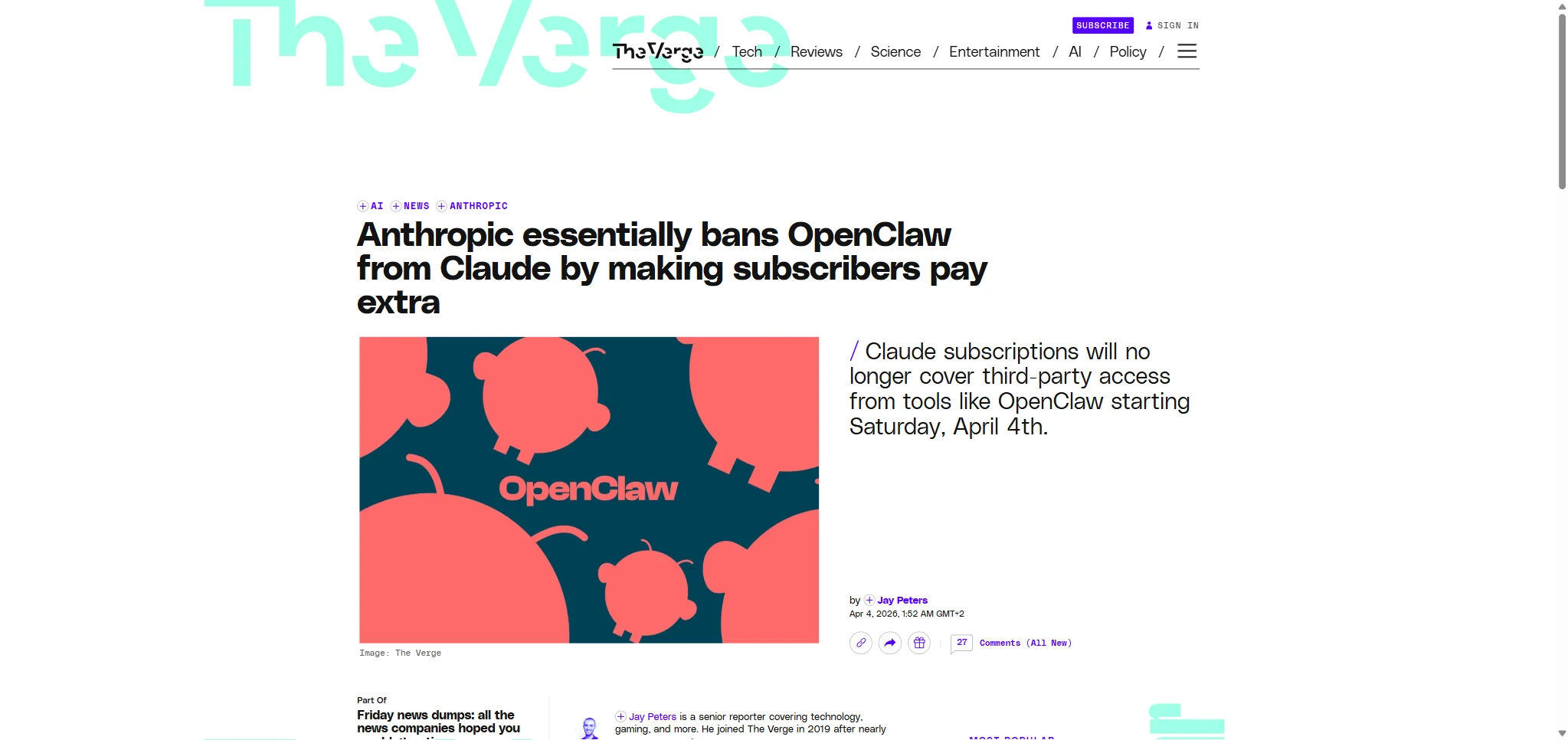
You may have woken up this morning to an email from Anthropic telling you your Claude subscription no longer works with OpenClaw. It is not a bug. It is a strategic decision, effective today, April 4, 2026, at 12 PM PT.
If you use Claude through OpenClaw, here is what happened, why, and what you should do now.
What happened
On the evening of April 3, Boris Cherny (Head of Claude Code at Anthropic) announced on X that Claude Pro ($20/month) and Max ($100-$200/month) subscriptions would no longer cover usage through third-party tools like OpenClaw. The cutoff went into effect on April 4 at 12 PM PT.
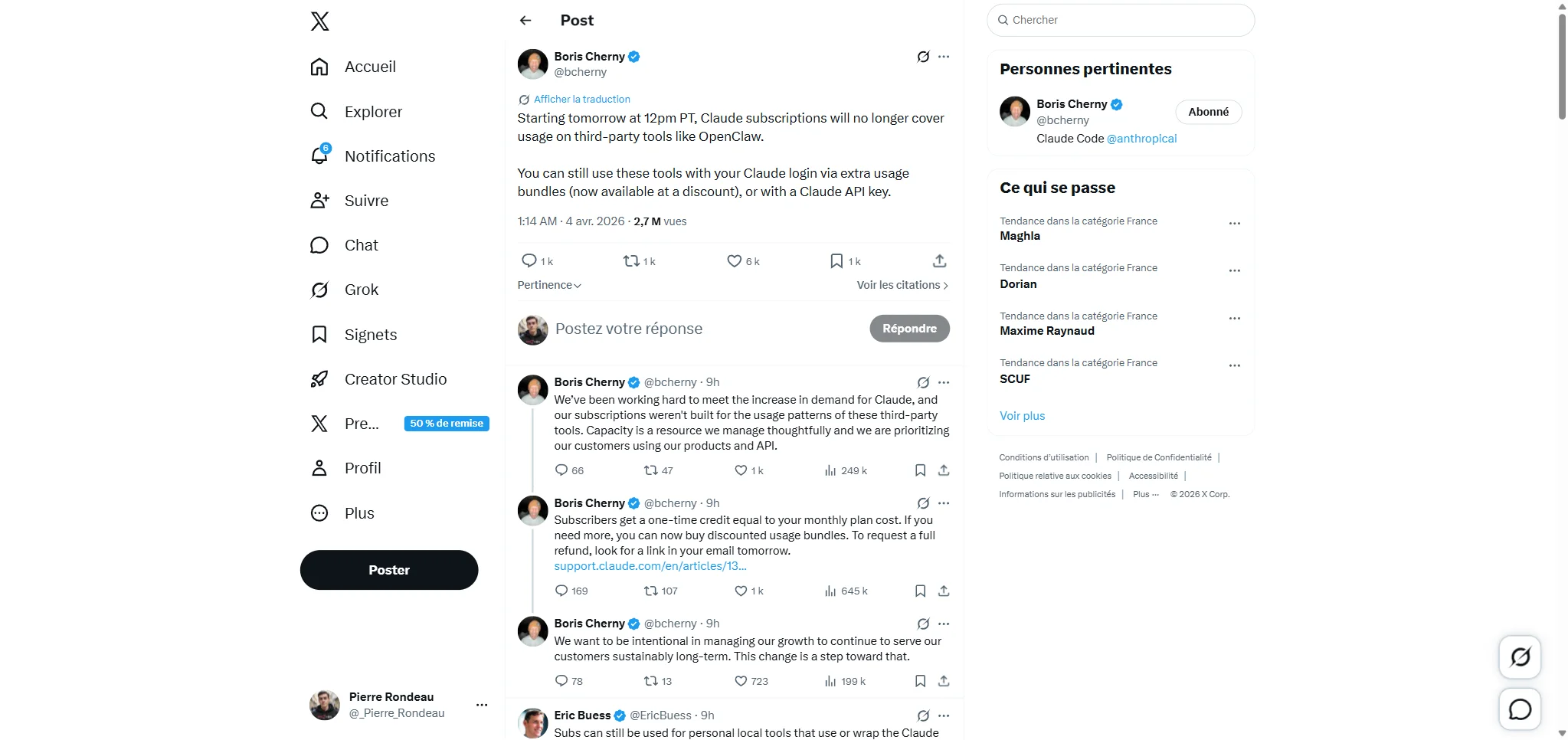
What changes in practice:
- Claude subscriptions no longer work with OpenClaw or any third-party harness
- Anthropic offers "extra usage bundles" as pay-as-you-go (up to 30% discount)
- Each agent task via pay-as-you-go costs between $0.50 and $2.00
- A one-time credit equivalent to one month of subscription is available until April 17
- The alternative: use a Claude API key directly
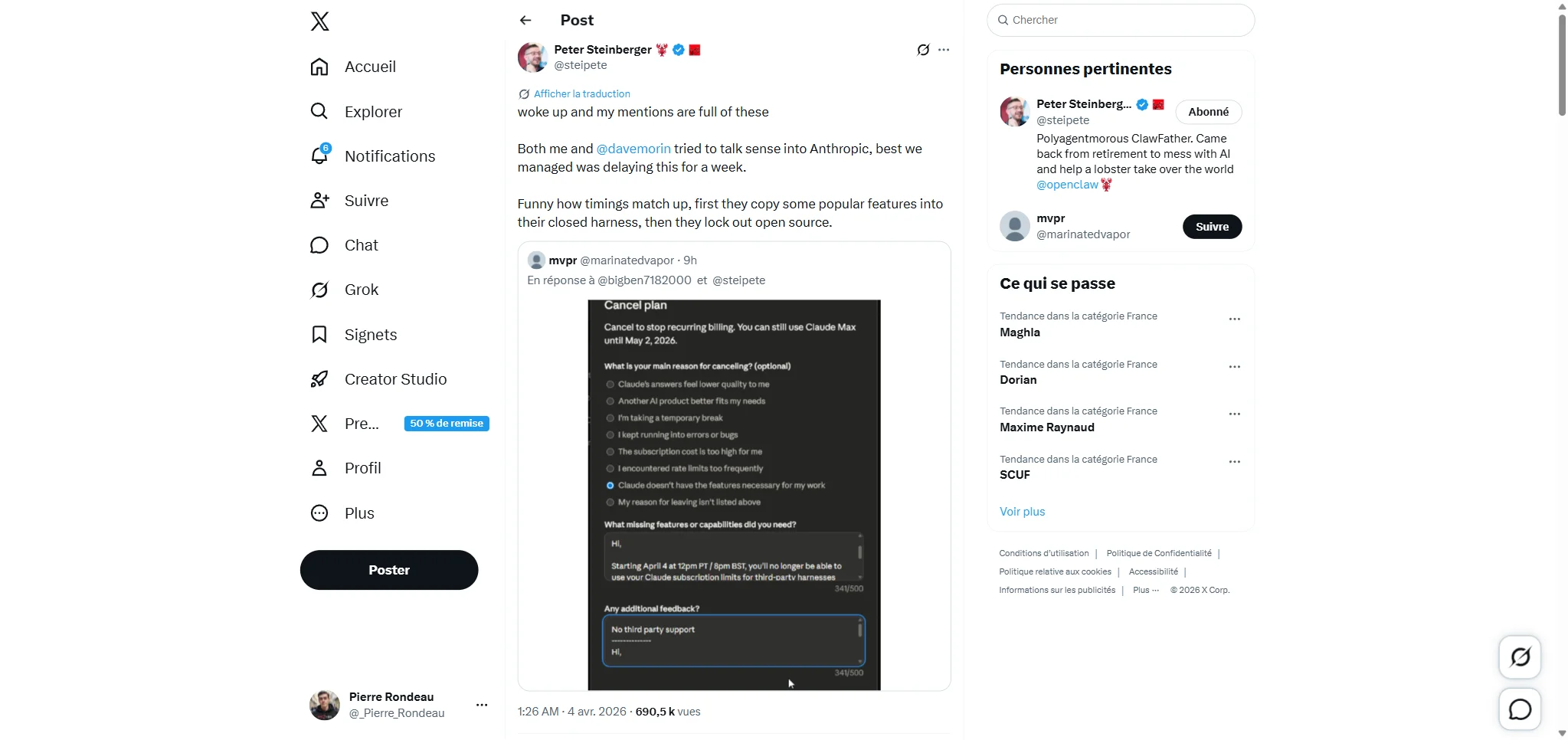
Peter Steinberger (OpenClaw's creator) and Dave Morin tried to negotiate a one-week delay. Anthropic refused.
Why now?
The economics problem
The number making the rounds on Reddit and Hacker News says it all: a $200/month subscription could consume up to $5,000 in compute through OpenClaw. That 1:25 ratio is not sustainable.
When a third-party tool lets you exploit a flat subscription for massive agent workloads, the model provider absorbs the loss. Anthropic called it "outsized strain on our systems" in their official announcement.
The signals we should have seen
The timeline is clear in hindsight:
- January 2026: Anthropic quietly blocks subscription OAuth tokens outside official apps
- February 2026: After backlash, Anthropic clarifies ToS and partially reverses course, temporarily re-authorizing OpenClaw
- February 2026: Peter Steinberger leaves OpenClaw to join OpenAI
- March 31, 2026: Claude Code's source code leaks via npm (we covered it here)
- April 3, 2026: Boris Cherny announces the definitive cutoff
- April 4, 2026: Cutoff goes into effect
Each event was a signal. Steinberger's departure to OpenAI likely accelerated the decision: why keep subsidizing an ecosystem whose founder now works for your direct competitor?
The product strategy
Anthropic is not cutting OpenClaw on a whim. The company is pushing its own tools: Claude Code (native terminal), Claude Cowork (collaboration), and the upcoming Claude Dispatch (orchestration). Every OpenClaw user who migrates to Claude Code is a user Anthropic controls end to end.
It is classic platform logic: open the ecosystem to grow, then close it once you have critical mass.
What this reveals about the AI ecosystem
Subsidized "free" always has an expiration date
The flat-subscription-vs-actual-usage arbitrage was too good to last. OpenClaw let you use Claude as an agent engine at a fixed price. It was an economic loophole, not a feature.
Every time a third-party tool gives you "unlimited" access to an AI service, ask yourself: who is paying the difference? If the answer is "the model provider, unwillingly," it will not last.
Harness vs. Moat
Last week's Claude Code source leak confirmed something important: the harness (the interface, the orchestrator) is not the value. The code was copied, mirrored, and rewritten in Python within hours. 50,000 GitHub stars in 2 hours.
The real value, the part that cannot be copied:
- Accumulated context: your CLAUDE.md files, your persistent memory, your project conventions
- Custom skills: your specific workflows, your automations
- MCP connections: your data servers, your business integrations
- The model itself: Claude's intelligence, accessible only through Anthropic
If your setup depends on a third-party harness to function, you are vulnerable. If your setup is built on context and skills, the harness is interchangeable.
Third-party tool dependency is an operational risk
Teams that built their agent workflows on OpenClaw now have to migrate on an emergency basis. Some Reddit posts describe 2-3 day migration sprints. Others report broken production workflows.
This is not a criticism of OpenClaw, which built a useful product. It is an observation: in today's AI ecosystem, the rules change fast, and the only thing you truly control is your own setup.
What to do now
1. Switch to the API for agent workflows
If you run agents, the Claude API is more predictable than a subscription. You pay for what you consume, with no risk of cutoff from a ToS change. Anthropic's "extra usage bundles" offer up to 30% off for high volume.
2. Build your own setup
Claude Code + MCP + custom skills = a setup nobody can take from you. Your project context (CLAUDE.md), your persistent memory, your custom skills: all of it lives in your repo, under your control.
Our setup at Claude Hub was not impacted at all by today's cutoff. Zero impact. Because it depends on no intermediary between us and the Claude API.
3. Invest in context, not the harness
Every hour spent configuring a precise CLAUDE.md, creating reusable skills, connecting your data sources through MCP: that is a durable investment. The harness changes; the context stays.
4. Claim the Anthropic credit
If you were on a subscription used through OpenClaw, claim the one-time credit before April 17. It is equivalent to one month of subscription, usable as API credit.
What comes next?
The harness wars are just getting started:
- OpenAI is positioning itself as a "harness-friendly" alternative by welcoming Steinberger and opening its ecosystem to third-party tools
- Nvidia announced NemoClaw (GTC 2026) to secure OpenClaw for enterprise use
- Open-source harnesses will multiply, but without the model behind them, they are only worth the integration they provide
The real question is not "which harness should I use?" It is: "does my setup survive when the harness disappears?"
If the answer is yes, you are in good shape. If the answer is no, now is the time to change that.
Sources: VentureBeat, The Verge, Business Insider, The Register, CyberSecurityNews, Reddit r/ClaudeAI, Hacker News
Pierre Rondeau
Developer and indie builder. I build products and automations with AI. Creator of Claude Hub.
LinkedIn