The server-side auto mode classifier gave no verdict: causes and fixes
"The server-side auto mode classifier gave no verdict": the server returned no safety verdict, so Claude Code denied the action. Causes and fixes.
The short answer
"The server-side auto mode classifier gave no verdict" is a Claude Code denial in auto mode: the server that reviews the action, as of v2.1.271 (September 14, 2026), returned no verdict (a timeout, an overlong conversation, a response cut short by an LLM gateway), and Claude Code denies the action rather than run it unreviewed. The error is not a ruling on your command. Send your message again; if the error comes back, check your gateway or set CLAUDE_CODE_AUTO_MODE_SERVER=0.
The server-side auto mode classifier gave no verdict (timed out), so auto mode cannot determine the safety of <tool>.The word in parentheses changes with the cause. (timed out) is the example on the errors page, which also lists (the conversation is too long for the check). <tool> is whichever tool was about to run: Bash, PowerShell and so on.
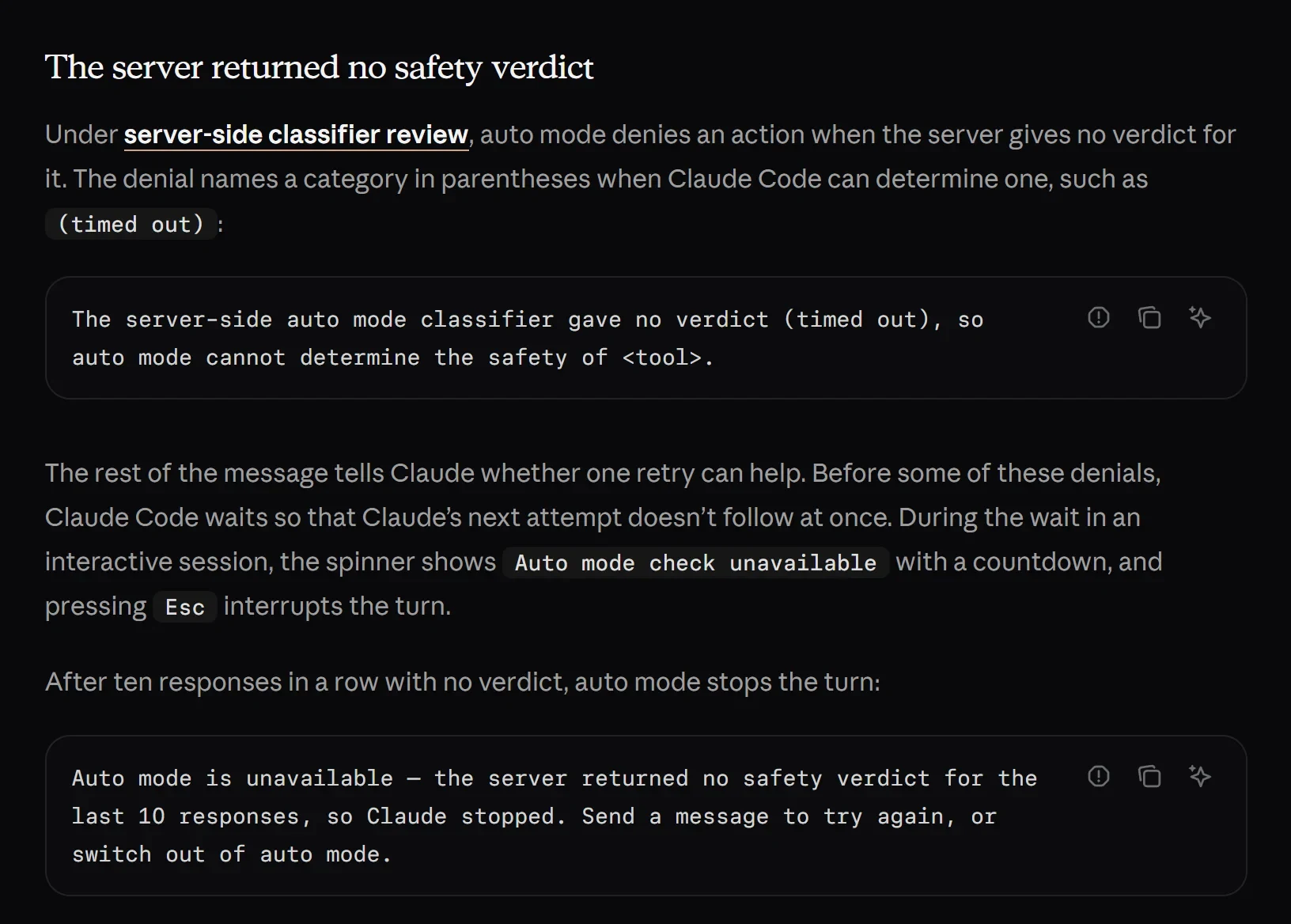
What does "The server-side auto mode classifier gave no verdict" mean?
In auto mode, a classifier reviews each sensitive action before it runs. Since v2.1.271 (September 14, 2026), Claude Code can ask the server to do that review as part of the session's model requests, instead of sending classifier requests of its own. v2.1.271 only covers interactive terminal sessions on Pro, Max, Ultra and Team plans. The rest followed in steps: v2.1.278 for Enterprise plans and Claude API accounts, -p runs, VS Code, cloud providers and gateways, then v2.1.281 for the Agent SDK and the desktop app.
When the server gives no verdict for an action, the docs put it plainly: "Claude Code denies the action rather than run it unreviewed". It is a fail-closed default, nothing more.
Why the server-side classifier gives no verdict
The permission modes page gives three causes:
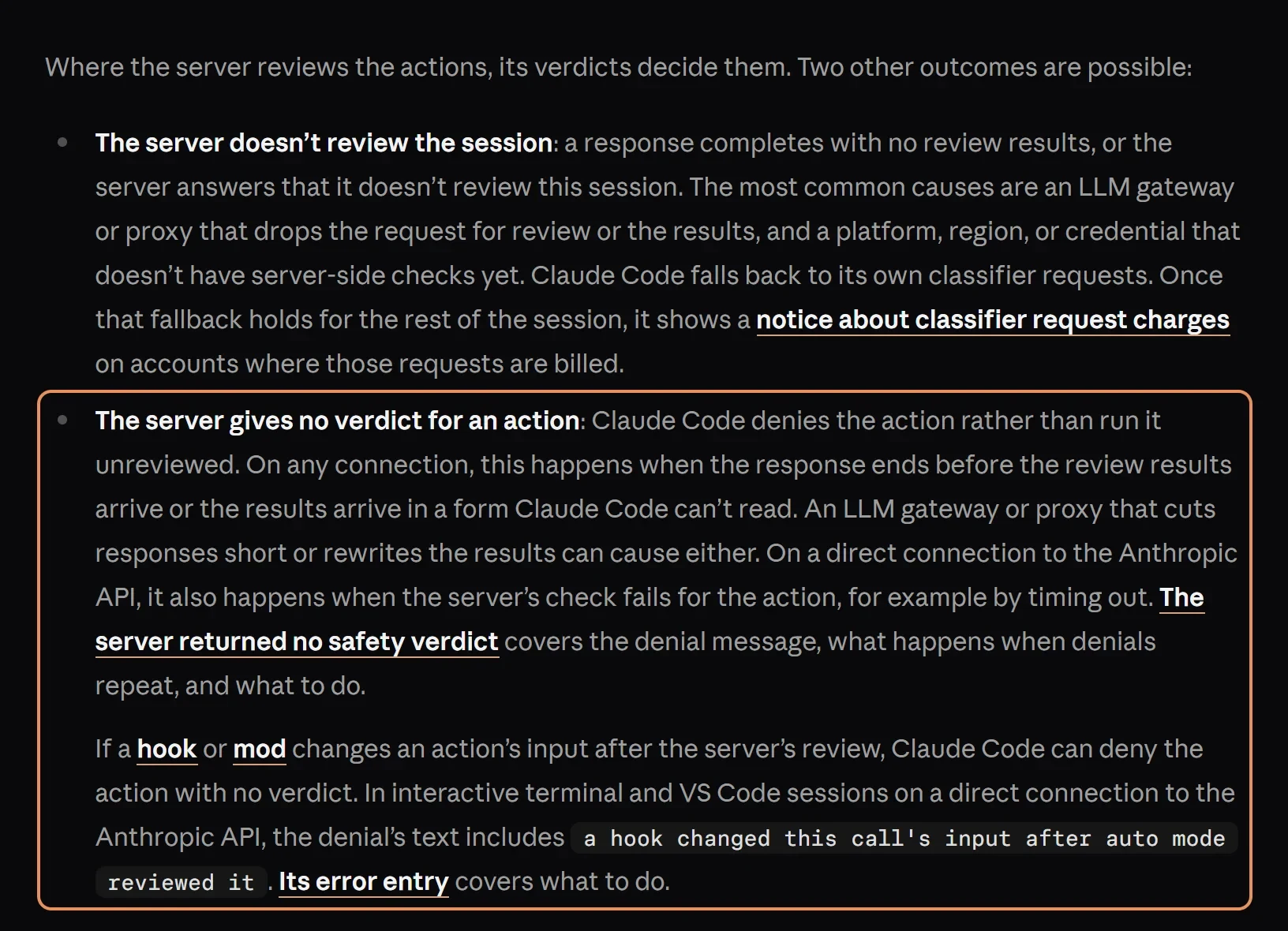
- The response ends before the review results arrive, or they arrive in a form Claude Code can't read. An LLM gateway or proxy that cuts streaming responses short or rewrites them can cause either.
- On a direct connection to the Anthropic API, the server's check fails for that action, for example by timing out.
- A hook or a mod changed the call's input after the review. The denial text then includes
a hook changed this call's input after auto mode reviewed it.
After ten responses in a row with no verdict, auto mode stops the turn, with a message containing the server returned no safety verdict for the last 10 responses. Before v2.1.280, each action was denied immediately and the turn never stopped.
How to fix the error
In order, straight from the errors page:
- Read the full text. In an interactive session, a dim
Not run · auto mode's check had no usable answerrow appears in place of the message:Ctrl+Oopens the transcript viewer so you can read it. - Send another message. The count of ten starts over.
- If the parentheses say
(the conversation is too long for the check), run/compact. Until the conversation is shorter you get the same denial. - Behind a gateway or proxy, check that it neither truncates nor rewrites streaming responses.
- Go back to Claude Code's own classifier with the variable below.
- Or leave auto mode (
Shift+Tab) and approve the action yourself.
CLAUDE_CODE_AUTO_MODE_SERVER=0: go back to Claude Code's own classifier
CLAUDE_CODE_AUTO_MODE_SERVER controls whether Claude Code asks the server to review auto mode actions. It requires Claude Code v2.1.271 or later. Set to 0, Claude Code stops asking the server and sends its own classifier requests:
{
  "env": {
    "CLAUDE_CODE_AUTO_MODE_SERVER": "0"
  }
}
Set it in your shell before starting Claude Code, or in the env key of ~/.claude/settings.json. Three caveats:
- On a direct Anthropic API connection, the variable is only read from v2.1.281 onward.
- Classifier requests become Claude Code's own again, and depending on your account they can be billed. See the classifier billing page, which also warns the variable is temporary and "may be removed in a later release".
- Since v2.1.319 (November 6, 2026), with telemetry or feature flags off, calls the server can't check are asked about or denied, with no fallback to the built-in classifier. Setting
0is how you keep it. Bedrock, Vertex and Foundry are unchanged.
Setting 1 does the opposite: on a direct Anthropic API connection, it turns server review on in a session that doesn't have it yet, unless CLAUDE_CODE_DISABLE_EXPERIMENTAL_BETAS=1 is also set.
What about "PowerShell denied by auto mode"?
When auto mode denies a PowerShell command, you are in one of these three documented situations:
- The classifier judged the command unsafe. Open
/permissions, go to the Recently blocked tab, and approve it. For a recurring command, add a narrowallowrule. - Your blanket
PowerShell(*)rule no longer applies. On entering auto mode, broad allow rules that grant arbitrary code execution are dropped. - It is a
Remove-Itemthat is always refused. On a drive root, your home directory, or a target ending in\*, Claude Code denies the command in every mode before the classifier sees it. No auto mode setting changes that.
The exact string "PowerShell denied by auto mode" does not appear in the documentation. What the docs describe is a notice shaped like bash blocked by auto mode · /permissions · Auto mode: [Data Exfiltration], led by the tool name.
In our release digests
- 2.1.277 and 2.1.278: the server-side classifier becomes the default
- 2.1.281:
CLAUDE_CODE_AUTO_MODE_SERVERon the direct API - 2.1.283: PowerShell and removals through
cmd - 2.1.319: no more silent fallback
FAQ
What does "The server-side auto mode classifier gave no verdict" mean?
In auto mode, Claude Code asked the server to review an action and got no verdict back. It denies the action rather than run it unreviewed. It is not a judgment that the command is unsafe. The word in parentheses, such as timed out, names the cause.
What does CLAUDE_CODE_AUTO_MODE_SERVER do?
It controls whether Claude Code asks the server to review auto mode actions. Set to 0, Claude Code uses its own classifier requests instead. Set to 1 on a direct Anthropic API connection, it turns server review on in a session that does not have it yet. It requires Claude Code v2.1.271 or later, and v2.1.281 or later on a direct Anthropic API connection. The docs describe it as a temporary setting.
Why is PowerShell denied by auto mode?
Three cases: the classifier judged the command unsafe, and you can approve it in /permissions under Recently blocked; your blanket PowerShell(*) allow rule is dropped on entering auto mode; or the command is a Remove-Item on a drive root, your home directory or a target ending in a wildcard, which Claude Code denies in every mode before the classifier sees it.
Why does auto mode stop after several denials?
After ten responses in a row with no verdict from the server, auto mode stops the turn. Send another message to try again and the count starts over. If it keeps happening behind an LLM gateway or proxy, check whether it cuts streaming responses short or rewrites them.

Pierre Rondeau
AI Engineer. I build AI agents and get them ready for production: datasets, evals, observability. Creator of Claude Hub.
LinkedIn