Everyone Teaches You to Use AI. Nobody Tells You How to Make Money With It
ChatGPT, Claude, 20 to 200 dollars a month. The real question isn't how to use AI, it's how to make your subscription pay for itself. Tier by tier.
Type "how to use ChatGPT" on YouTube. Millions of views. Hundreds of tutorials showing you how to write a prompt, plug in a GPT, summarize a PDF.
Now type "how to make my AI subscription pay for itself." Radio silence.
That's the gaping hole in the market. Everyone teaches you to use the tool. Almost nobody shows you how it earns back the 20, 100, or 200 dollars it costs you every month. The result: most people pay for a subscription and treat it like a fancier Google. They buy a Ferrari to go pick up bread.
This article flips the problem. Not "here are 10 magic prompts." Instead: at each price tier, which concrete use case pays your subscription back, proven with real numbers.
The principle: one use case is enough to break even
The logic is simple, and it fits on one line.
Your ROI = (hours saved x your hourly rate) + direct revenue + tools you cancel - the subscription price.
If that number is positive, the subscription is profitable. Done. And the bar is lower than you think: at 20 dollars a month, a single hour of work saved in the month already covers it for most people.
The trap is never the price. It's not knowing which use case unlocks that ROI. Let's unlock it tier by tier.
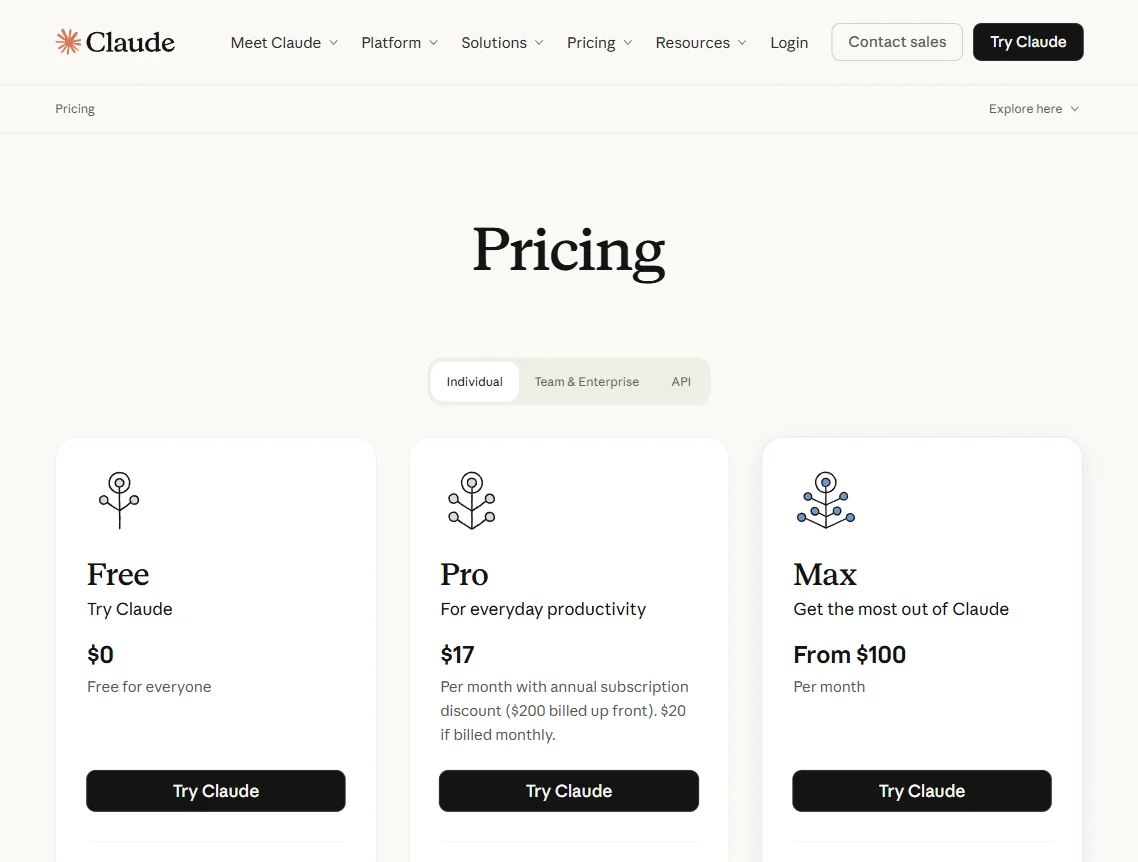
Tier 0: Free (0 dollars)
The free tier has nothing to pay back. It's the "I get it now" tier.
Its only job: make you live the "oh, I see" moment. Delegate a chore you hate. The annoying client email you've been putting off for two days. The administrative letter. The 40-page document summary you don't have the energy to read. Thirty seconds, done.
If that moment doesn't spark anything, don't pay. If you catch yourself thinking "I could do this all day," you're ready for the next tier.
Tier 1: Pro (17-20 dollars)
This is the tier for the solo worker, the curious employee, the side project. And it's the best value-for-money on the entire market, no exceptions.
Two ways to pay it back, often within the first week.
You cancel 3 or 4 subscriptions. Grammar checker (10 $), DeepL Pro for translations (8 $), a contract template generator, a summarizing tool. On their own, the tools you replace already top 20 dollars. You haven't even mentioned productivity and the subscription is already paid for.
You save hours. A sharp sales email, a product description, a LinkedIn post, a brief: 2 hours saved a week, easily. Even at a modest hourly rate, the math is settled.
The truth is that for most independents, the Pro tier is more than enough. Don't upgrade until you cap out. We'll come back to this, it matters.
Tier 2: Max 100 dollars (5x)
Here, you change category. We're no longer talking about saved time, we're talking about direct revenue.
With Claude Code (the agent that codes in your terminal) and artifacts, you ship things you used to outsource. A mini-site, an automation script, a scraper, an internal tool. What you paid a developer 300 to 500 dollars to do, you produce yourself.
The math gets absurd. As one developer puts it on Reddit:
"I get my value for it within an hour of billable time. It's a drop in a bucket compared to what I'd be paying an analyst or junior dev to do."
On the content side, the jump is just as clear. Startup Copy.ai reports, in an Anthropic case study, 4x more content produced and 75% lower costs after integrating Claude. You go from one article a week to five. More SEO, more leads, more fuel for your newsletter.
This is the "sweet spot" tier for most pros working with AI daily. Five times the Pro limit, enough to sustain 2 to 3 hour sessions without interruption.
Tier 3: Max 200 dollars (20x): the uncomfortable truth
This is the tier everyone fantasizes about and almost nobody should buy.
Let's say it plainly: the 200 dollar plan is profitable mostly when you're a company, or a power user running several agents in parallel all day. For a typical freelancer, it's often too expensive for a need that doesn't exist.
This isn't my isolated opinion, it's what users say themselves.
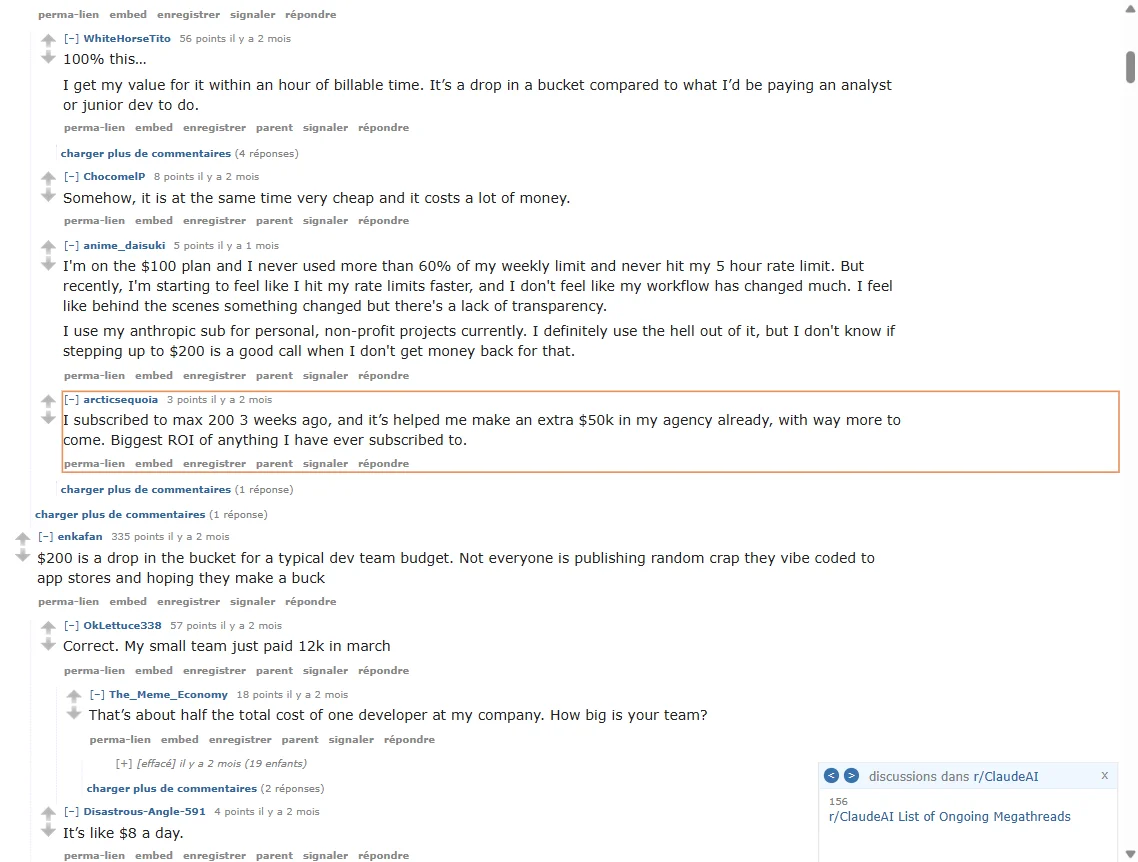
Look closely at that screenshot. You've got both camps. On one side, the huge ROI:
"I subscribed to max 200 3 weeks ago, and it's helped me make an extra $50k in my agency already, with way more to come. Biggest ROI of anything I have ever subscribed to."
On the other, the nuance that should speak to you if you're a freelancer:
"I'm on the $100 plan and I never used more than 60% of my weekly limit."
And the line that sums it all up:
"$200 is a drop in the bucket for a typical dev team budget."
That's the real message. Someone explains their team paid "12k in March, about half the total cost of one developer." For a company, 200 dollars a month is free. For an independent who doesn't use half their limit, it's 100 dollars thrown away.
The 70% rule
Keep this one in mind, it's worth the rest of the article:
If you're not using at least 70% of your weekly limit, you're paying too much. Drop a tier.
Plenty of people who think they need the 200 actually cap out at 30-35% usage, even pushing 8 hours a day. They're paying for headroom they never touch. The right move: start at Pro, step up to Max 5x when you cap out, and only touch the 200 the day you're permanently running several simultaneous agents.
"But I burn through all my tokens in two days!"
That's objection number one. "I got Max and I blow my limit before the weekend, so I need the tier above."
No. In 90% of cases, you're not consuming too much, you've just misconfigured Claude Code.
The culprits are always the same:
- Opus as the default model. Opus costs roughly 1.7 times more than Sonnet in quota ($5 vs $3 per million tokens on the API side). For 80% of tasks, Sonnet does the same job. Keeping it as default cuts your runway by 40% for nothing.
- Tool search switched off. Claude Code defers MCP tool definitions by default, but not on Bedrock, and not behind a corporate proxy. In those cases the GitHub server alone and its 93 tools eat 55,000 tokens before your first message.
- No
/clear. You're dragging a context several hours long that gets billed on every message.
One developer put it bluntly: Claude Code can, without you noticing, burn 10 to 20 times your token budget. The good news is that the reverse discipline easily recovers 50 to 60% of quota.
Before paying 100 dollars more, tune your machine. I broke it all down here: Saving tokens on Claude Code: stop blowing your quota.
What to remember
Making money with AI isn't about the tool, it's about execution. Most people cap out between $0 and $500 a month for one simple reason: they don't consistently pursue clients. The tool doesn't make the money. Your business execution does.
And the golden rule, if you sell services: sell the deliverable, never the AI. Show a result, not your tool. "I use AI," everyone says that now, it moves no rates.
The right tier isn't the most expensive one. It's the one whose limit you hit 70% of. Start low, move up when you cap out, tune your machine before overpaying.
Want the concrete workflows that pay back each tier, tested for real? Check out the Claude Hub resources, I share what works, without the YouTube noise.

Pierre Rondeau
Developer and indie builder. I build products and automations with AI. Creator of Claude Hub.
LinkedIn