Agent Skills: How Anthropic Created an Open Standard the Entire Industry Is Adopting (and Why It Changes Everything)
Anthropic's Agent Skills went from a Claude feature to an industry standard in two months. OpenAI is copying them, Microsoft is integrating them.
October 2025: Anthropic launches a feature called "Skills" for Claude. Two months later, OpenAI quietly copies it. Three months later, Microsoft ships it in VS Code. Today, it's an open standard adopted by more than ten platforms, with a community ecosystem of hundreds of skills.
The topic is almost absent from the French web, and even English-language coverage rarely connects the dots. A few articles scratch the surface, but none cover the full timeline, the strategy behind the standard, and the adoption by OpenAI and Microsoft. This article fills that gap.
I use Agent Skills in production every day. Dozens of custom skills power my workflow: LinkedIn carousel generation, automated code reviews, industry monitoring, lead enrichment. This isn't theory; it's ground-truth feedback on a standard that's reshaping how we work with AI agents.
What an Agent Skill actually is
A Skill is a folder with a Markdown file and optional resources. That's it.
carousel/
├── SKILL.md          # Required: metadata + instructions
├── scripts/          # Optional: executable code
├── references/       # Optional: detailed documentation
├── assets/           # Optional: templates, resources
└── ...
The SKILL.md file contains a required YAML frontmatter followed by free-form Markdown instructions:
---
name: pdf-processing
description: Extract PDF text, fill forms, merge files. Use when handling PDFs.
license: Apache-2.0
metadata:
  author: example-org
  version: "1.0"
---

[Markdown instructions here]
The required fields are name (max 64 characters, lowercase plus hyphens) and description (max 1024 characters). The description plays a dual role: it explains what the skill does AND when the agent should activate it. That's the trigger mechanism.
Optional fields: license, compatibility (environment prerequisites), metadata (arbitrary keys like author, version, etc.), and allowed-tools (a pre-approved list of tools, still experimental).
The simplicity is deliberate. Anthropic's blog puts it plainly: "Skills are a simple concept with a correspondingly simple format. This simplicity makes it easier for organizations, developers, and end users to build customized agents."
Progressive disclosure: the key concept
The format relies on three loading levels, a principle the spec calls "progressive disclosure":
- Metadata (~100 tokens):
nameanddescriptionloaded at startup for every available skill. The agent scans them to know which skills exist and when to activate them. - Instructions (< 5,000 tokens recommended): the full body of SKILL.md, loaded only when the skill is activated.
- Resources (on demand): files in
scripts/,references/,assets/, loaded only when the agent needs them.
Anthropic's official analogy: think of it like a well-organized manual that starts with a table of contents, then specific chapters, and finally a detailed appendix.
The recommendation: keep the SKILL.md under 500 lines and move detailed references to separate files. That's exactly what I do with my clean-code skill, which loads the core principles in SKILL.md and keeps detailed references in a references/ folder.
The timeline: from a feature to an industry standard
| Date | Event |
|---|---|
| October 16, 2025 | Anthropic launches Skills for Claude (internal feature) |
| December 9, 2025 | Anthropic transfers MCP to the Linux Foundation (co-founds the AAIF with OpenAI and Block) |
| December 12, 2025 | Elias Judin discovers that OpenAI is copying the format in ChatGPT and Codex CLI |
| December 18, 2025 | Anthropic publishes Skills as an open standard on agentskills.io |
| January 2026 | VS Code Insiders supports Agent Skills (GitHub Copilot) |
| February 5, 2026 | VS Code blog: Skills in GA, Claude + Codex as agents inside VS Code |
| March 2026 | Broad adoption: Udemy courses, community marketplace, awesome-list of 181+ skills |
Two months between the internal launch and the release as an open standard. That's fast, even by Anthropic's standards.
OpenAI copies the format: the Elias Judin discovery
On December 12, 2025, developer Elias Judin shared a surprising finding on X. He asked ChatGPT Code Interpreter to zip his /home/oai/skills folder. The result: pdfs/ and spreadsheets/ folders containing skill.md files with a structure "structurally identical" to the Anthropic spec. Same naming conventions, same metadata format, same organization.
Simon Willison, an undisputed reference in the dev community, confirmed and documented the discovery:
"A skill is just a folder with a Markdown file and some optional extra resources and scripts, so any LLM tool with the ability to navigate and read from a filesystem should be capable of using them. It turns out OpenAI are doing exactly that."
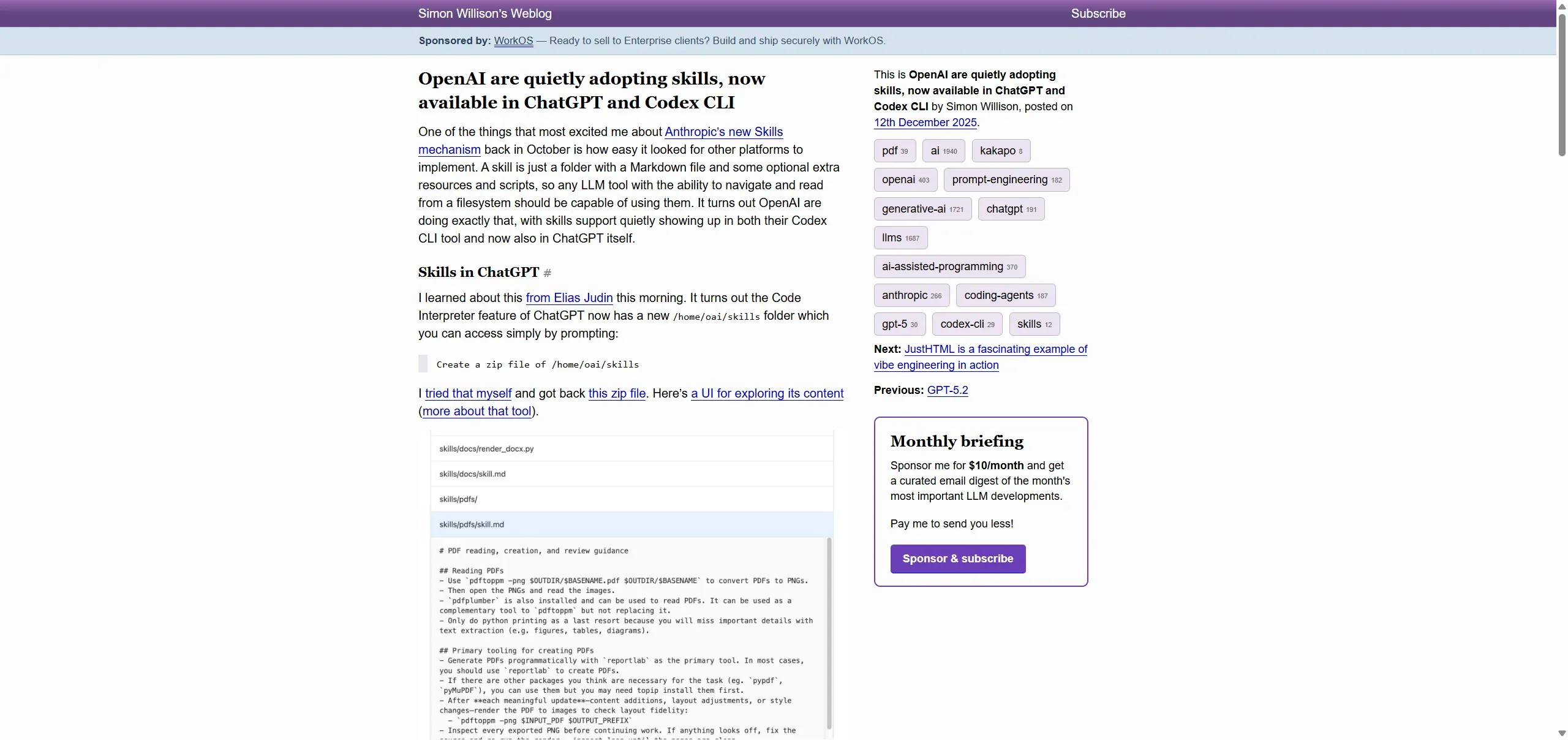
Support was also found in Codex CLI through a pull request titled "feat: experimental support for skills.md". OpenAI never officially announced this adoption at the time of the discovery. Since then, the developers.openai.com/codex/skills page has made the support official.
It's a strong signal. When your main competitor adopts your format without even announcing it, that format is solving a real problem.
Microsoft joins the dance
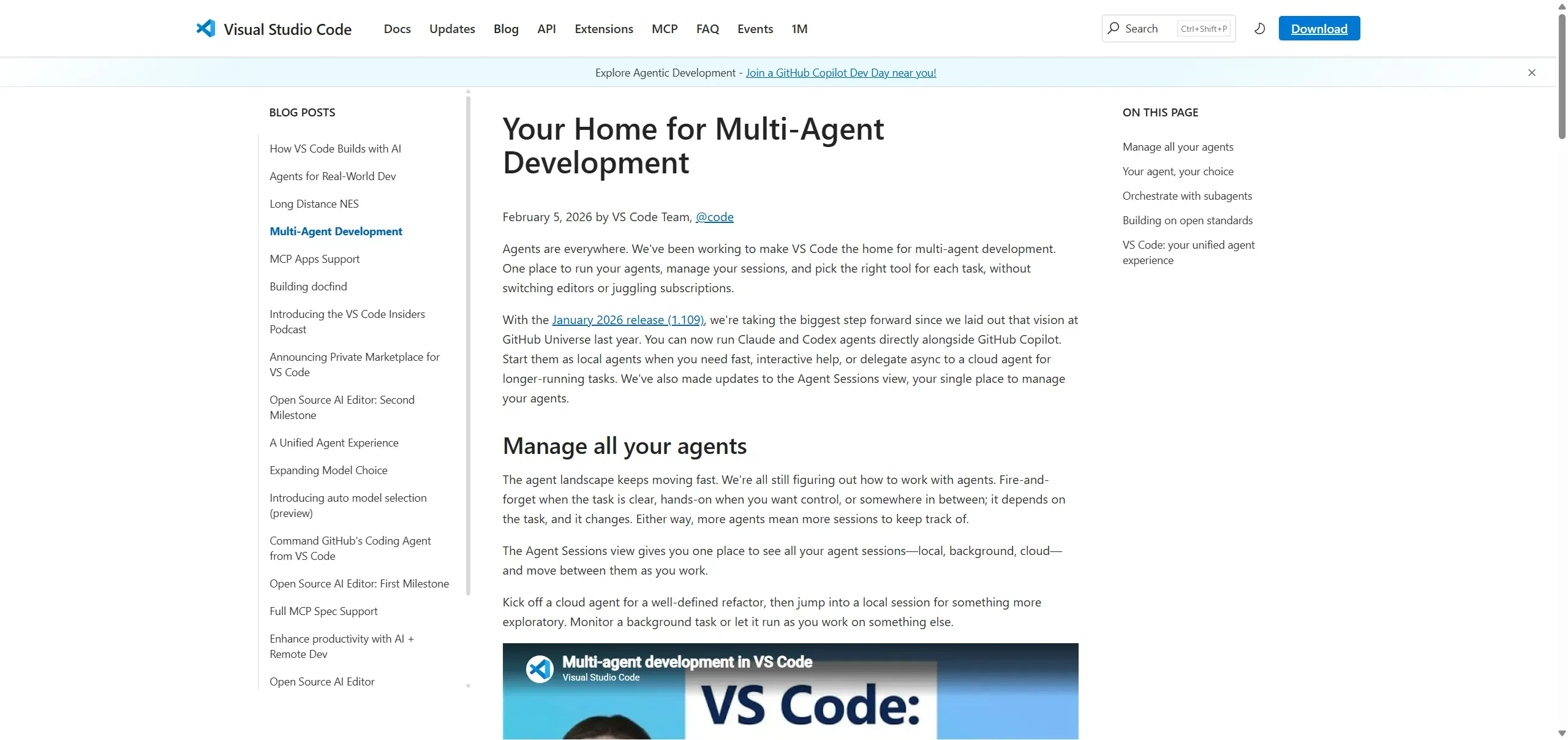
VS Code's adoption may be the most significant signal of all. The official VS Code blog from February 5, 2026, states it clearly:
"We've also made Agent Skills, Anthropic's open standard for extending AI agents, generally available."
The blog directly references the anthropics/skills repo as the source. GitHub Copilot in VS Code loads skills from the project's local folder. To enable it: Preferences > Settings > "Use Agent Skills".
The blog's framing captures the value proposition well: "Skills are specialized capabilities that help agents produce high-quality outputs; they provide tested instructions for domains like testing strategies, API design, or performance optimization."
When Microsoft ships an Anthropic standard inside its code editor used by millions of developers, the standard has won.
Who has adopted it (full list)
The list of platforms that natively support Agent Skills:
- Claude Code, Claude.ai, Claude Agent SDK, Claude API (Anthropic): native
- GitHub Copilot / VS Code (Microsoft): GA since February 2026
- Codex CLI + ChatGPT (OpenAI): officially supported
- Cursor: confirmed by Anthropic
- Goose (Block): confirmed
- Amp: confirmed
- OpenCode: confirmed
- Factory: confirmed
- ModelScope MS-Agent (Alibaba): since v1.6.0rc1, February 2026
On the ecosystem side:
- agentskills.io: official spec site (14,800+ GitHub stars, 871 forks)
- SkillsMP.com: independent community marketplace
- awesome-agent-skills: 181+ listed skills
- SkillsBench: academic benchmark (86 tasks, 11 domains)
And the official Anthropic Skills Directory partners, confirmed by VentureBeat: Canva, Notion, Figma, Atlassian (Jira, Confluence), Zapier, Stripe, Cloudflare.
Mahesh Murag, Anthropic product manager, explains: "Partners who build skills for the directory do so to enhance how Claude works with their platforms. It's a mutually beneficial ecosystem relationship similar to MCP connector partnerships."
Skills vs MCP: two complementary standards
A frequent confusion: Skills are NOT tool calling. MCP and Skills solve different problems.
MCP (Model Context Protocol) is about which tools the agent can use. It's the connection to external systems: APIs, databases, third-party services. MCP provides the capabilities.
Agent Skills are about how the agent should work. They're procedural instructions loaded into the agent's context. Skills provide the expertise.
A Hacker News comment nails it: "Skills has nothing to do with tool calling at all."
In practice, the two complement each other. My lead-enrichment skill uses MCP servers (Unipile for LinkedIn, Notion for the CRM) to execute its actions, but the skill's instructions define the process: in what order to enrich data, which fields to prioritize, how to format the output. MCP is the "what", Skills is the "how".
Anthropic's strategy: the MCP playbook, act II
The pattern mirrors MCP, and it's intentional:
- Anthropic creates a spec that solves a real interoperability problem
- Publishes it as an open standard
- Adoption creates value for the entire ecosystem
- Anthropic benefits because Claude is the best at using its own standards
MCP: launched November 2024, transferred to the Linux Foundation December 2025. Skills: launched October 2025, open standard December 2025.
Barry Zhang (Anthropic) laid out the strategic frame at a November 2025 conference: "The agent underneath is more universal than previously thought. Enterprises may get better ROI by curating skills (institutional best practices) instead of deploying multiple bespoke agent systems."
VentureBeat reads the move: "The decision to release Skills as an open standard is a calculated strategic choice. By making skills portable across AI platforms, Anthropic is betting that ecosystem growth will benefit the company more than proprietary lock-in would."
Unite.AI confirms: "The pattern is deliberate. Anthropic builds specifications that solve genuine interoperability problems, releases them as open standards, and lets adoption create value that accrues to the ecosystem rather than to Anthropic alone."
It's a bet on standardization over lock-in. And given three months of adoption, the bet looks like a winner.
In practice: how I use Skills day to day
I'm 3x Anthropic certified (Claude API, MCP Advanced, Claude Code). I've used Agent Skills in production every day since launch. My public repo claude-skills-public contains a subset of my skills, the ones I share with the community.
My setup
Seven public skills covering three areas:
Content and LinkedIn: carousel (HTML/PDF carousel generation), infographic (social-media infographics), linkedin-post-notion (post drafting with Notion publishing), linkedin-veille (monitoring of trending posts).
Development: clean-code (Uncle Bob's Clean Code/Clean Architecture principles applied automatically to every review).
Business and CRM: lead-enrichment (prospect enrichment via LinkedIn and Notion), meeting-recap (structured notes, follow-up emails, actions pushed to Notion).
And plenty more in private: a productivity copilot that checks my calendar and routines, a systematic debugging system, brainstorming and planning skills.
A concrete example: the carousel skill
Here's the frontmatter of my carousel skill:
---
name: carousel
description: Use when the user wants to create a LinkedIn carousel.
  Also use when the user mentions "carousel", "carrousel",
  "slides LinkedIn", or asks to create slides for social media.
license: MIT
compatibility: Requires Node.js for screenshot/PDF pipeline
  (Puppeteer or Playwright).
metadata:
  author: PierreRtec
  version: "1.0.0"
allowed-tools: Read Edit Write Glob Grep Bash(node:*) Bash(npx:*)
---
The description does double duty: it explains what the skill does AND lists the triggers. When I type "make me a carousel on the 5 prompt engineering mistakes", Claude Code automatically matches the skill, loads the full instructions, and runs the workflow: brainstorming slides, generating HTML, capturing PNGs via Playwright, exporting PDF.
The allowed-tools field is an experimental feature that restricts the tools a skill can use. My carousel skill doesn't need internet access or permission to modify my Git config; it just needs to read/write files and run Node.
What it illustrates
This is exactly Barry Zhang's vision: a single universal agent configured with specialized skills. No need for ten different tools for ten workflows. One agent (Claude Code), skills that define how it works on each task type, and MCP servers that give it access to external systems (Notion, LinkedIn, Google Calendar).
The result: a personalized AI copilot that adapts to each context. When I write code, the clean-code skill activates in the background. When I prep LinkedIn content, carousel or infographic takes over. When I wrap up a client call, meeting-recap structures my notes.
Risks worth knowing
A 2025 academic paper ("Agent Skills Enable a New Class of Realistic and Trivially Simple Prompt Injections") documents a real risk: skill files are potential prompt injection vectors. A malicious skill can inject instructions that hijack the agent's behavior.
It's the tradeoff baked into the format: the simplicity (human-readable Markdown) is also what makes injection trivial. Installing a third-party skill is like installing an npm package: you need to vet the source, read the code, understand what it does.
The official spec doesn't yet provide a signing or sandboxing mechanism. The allowed-tools field is a first step, but it's still experimental. For now, the responsibility lies with the user.
What it changes for developers and companies
For individual developers: Skills transform how we configure AI tools. Instead of repeating the same instructions every session, you write a skill once and the agent applies it automatically. It's DRY code, applied to agent instructions.
For teams: Barry Zhang sums it up well. Companies can get a better ROI by curating skills (codified institutional best practices) than by deploying multiple bespoke agent systems. A "code review per our internal conventions" skill shared in the team repo has more impact than a proprietary tool.
For the ecosystem: interoperability is the real win. A skill written for Claude Code works in VS Code, in Cursor, in Codex CLI. Write once, use everywhere. That's the promise, and current adoption shows it's becoming reality.
For Anthropic: the same network effect as MCP. The bigger the skills ecosystem grows, the more useful Claude becomes, the more developers stay on Claude. The open standard is the product.
Skills are available on every Claude plan: Free, Pro, Max, Team, Enterprise. API usage follows standard API pricing.
Sources: Official spec agentskills.io, Anthropic blog, GitHub spec, VS Code blog, Simon Willison, VentureBeat, Unite.AI, ZDNet

Pierre Rondeau
Developer and indie builder. I build products and automations with AI. Creator of Claude Hub.
LinkedIn